Extreme weather events are striking with increasing frequency – scorching heat, gales, and severe convective storms taking turns to wreak havoc. Among them, torrential rain stands out for its particularly devastating impact on cities.
As spaces where population and economic activity are highly concentrated, cities have long operational chains and deeply interconnected systems. The shock of intense rainfall is therefore more intense and the losses more pronounced – a single extreme rainstorm can bring a modern metropolis of 10 million people to a grinding halt in a few hours.
How can it be withstood? This is the question every city must answer.
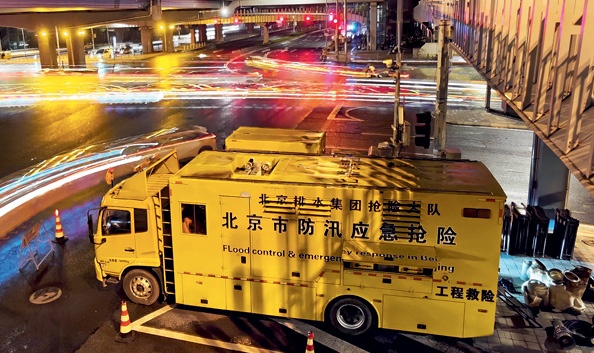
Amid a rainstorm warning, emergency vehicles of the Beijing Drainage Group are staged and on standby beneath the Jin’an Bridge in Shijingshan District, Beijing on July 10, 2026.
Why So Vulnerable to a Downpour?
On the morning of July 12 this year, residents in Beijing’s suburban Tongzhou District and Yizhuang Economic and Technological Development Area stepped out to find multiple road sections submerged and impassable. During some areas in the past, water had reached mid-calf, severely disrupting daily commutes. The night before, Beijing had been hit by the strongest rainfall since the start of the flood season, with peak hourly intensities exceeding 50 millimeters.
Since the flood season began, the national average precipitation has reached 157.4 millimeters – 12.2 percent above the seasonal norm and the second highest for the same period in the past decade.
Torrential rain does not merely cause urban waterlogging; at its most severe, it can tear through any city’s multiple layers of defenses.
During the 2021 extreme rainstorm in Zhengzhou, central China’s Henan Province, flooding inundated underground spaces in over half of the city’s residential communities, while multiple districts suffered simultaneous power, water, and online outages. In September 2023, Shenzhen was battered by a record-breaking rainstorm that shattered multiple rainfall metrics dating back to 1952, forcing the closure of several subway stations due to inundation.
When extreme rain strikes, a city’s fragility is laid bare. Why do functionally advanced modern cities so often malfunction under the pressure of heavy rainfall?
“China’s urbanization has entered its later stage. Roads and drainage networks built three to four decades ago are now reaching the end of their service life and entering a cycle of renewal and replacement,” said Zou Liang, deputy director of the Urban Safety and Disaster Prevention Planning Committee under the Urban Planning Society of China.
Zou found during his research that a large number of drainage pipelines constructed from the 1990s to the early 2000s face outdated design standards. Coupled with years of sedimentation, blockages, and aging, the actual flow capacity of these pipes can no longer accommodate the heavy rainfall that is increasingly more frequent now.
The mismatch between design standards and climate change is a common challenge facing urban pipeline networks across the country. Zhang Yingxia, deputy chief engineer at the Institute of Shanxi Architectural Design and Research Co., Ltd., explained that early Chinese drainage networks were primarily designed based on historical rainfall data, generally for a one-to-three-year return period. “But the pace of climate change has outstripped the pace of standard revision,” she said.
What were once considered low-probability extreme rainfall events, once in 50 or 100 years, are now occurring with significantly greater frequency, creating a clear gap between designed capacity and actual rainfall intensity.
The continuous decline in cities’ natural rainwater absorption capacity is another major cause of waterlogging.
“During rapid urban development, natural pervious surfaces such as soil have been replaced by impervious surfaces like concrete,” Zhang explained. “Most rainwater can no longer infiltrate the ground, so runoff simply flows along roads into the drainage network.”
“The more modern a city becomes, the more interconnected its operating systems are,” Zou said. According to him, when heavy rain strikes, it exposes not only drainage deficiencies but also a cascade of secondary emergencies – traffic paralysis, power outages, and communication base station failures – when waterlogging becomes severe.
Compared with southern cities, the challenges facing northern cities are even more daunting.
Meteorological data shows that the rain belt is gradually shifting northward, with average precipitation for June in north China reaching its highest level in nearly a decade. The notion that “north China does not experience major floods” is becoming a thing of the past.
Yet north cities have long operated under the assumption of “low rainfall,” meaning any unexpected downpour comes as a major test.
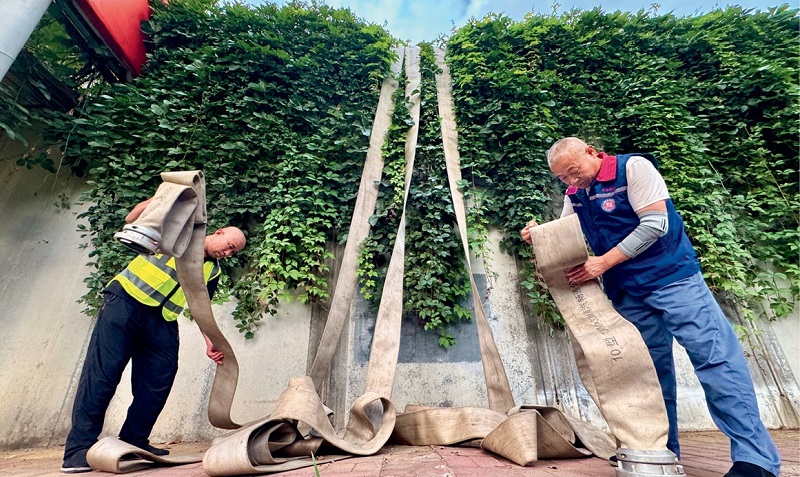
No. 3 Flood-Control and Emergency Brigade of the Fengtai Water Authority is mobilizing for dewatering operations at a railway overpass near Xinfadi in Fengtai District, Beijing.
How to Fortify Defenses?
With the increase of extreme rainfall, urban flood control is shifting from passive emergency responding to systematic, long-term strategic planning. In April 2026, the Political Bureau of the CPC Central Committee called for strengthening the planning and construction of “six major networks,” with urban underground pipeline networks being one of them. During the 15th Five-Year Plan period (2026-2030), approximately 770,000 kilometers of urban underground pipelines will be built or upgraded nationwide. In 2026 alone, the central government has allocated RMB 160 billion to support these efforts.
Across the country, cities are moving swiftly to address shortcomings in drainage and flood prevention. Work is being advanced in a coordinated manner across multiple fronts: sponge city development, climate-resilient city pilots, pipeline network renewal, and the construction of smart flood control systems. These integrated measures are steadily enhancing urban flood management capacity.
As a typical inland city in north China, Taiyuan, the capital city of Shanxi Province, is directly confronting the challenges posed by increasing and intensifying rainfall during the flood season. Taking 2025 as an example, the city’s annual precipitation was 40 percent above the seasonal norm. Furthermore, its unique topography – characterized by higher elevations in the north and south, mountains to the east and west, and the Fenhe River running through the city – means that its natural drainage is inherently constrained. Coupled with pipeline issues such as outdated standards, aging, and sedimentation, Taiyuan has long faced immense pressure in the area of flood control.
In recent years, Taiyuan has steadily advanced the upgrading and quality improvement of its pipeline network. As part of its urban renewal and rainwater-sewage separation campaign, the city has renovated hundreds of kilometers of combined sewer networks, redesigned over 3,000 cross-connections between rainwater and sewage lines, and upgraded storm sewers along major roads to a 5-year recurrence interval. These efforts have been synchronized with optimized road vertical designs, enhancing the network’s collection and drainage capacity right from the source.
Limited space in old residential communities and complex underground pipelines represent common challenges for cities nationwide.
Taiyuan’s approach is to implement targeted measures using small, focused interventions to drive substantial governance outcomes. The city conducts routine pipeline dredging, clearing hundreds of kilometers of pipes and tens of thousands of manholes annually. Through micro-renovations – such as installing combined flat and side inlets, adjusting drainage curbs, and adding anti-falling safety facilities – Taiyuan has been able to address localized waterlogging with relatively minimal investment.
Xinghua Street was once one of the sections most severely affected by waterlogging in Taiyuan. Residents living on the street recalled that during previous rainy seasons, they had to move their cars to higher ground in advance, and the ground floors of older buildings would inevitably flood with every downpour. “Water poured in through the door gaps – even sandbags didn’t work,” one resident remembered.
In 2024, a renovation project was completed, and there has been no recurrence of severe waterlogging on that street since then.
Underground passages – with their low-lying topography, rapid water convergence, and narrow escape windows – are high-risk points for urban flooding. Relying solely on pipeline drainage is insufficient to cope with extreme rainfall. To address this vulnerability, Taiyuan has built a multi-tiered emergency response system: the city has established 15 municipal emergency support bases and 15 flood response teams, forming a 15-minute service coverage circle across the main urban area. Over 140 emergency vehicles provide a mobile pumping capacity of nearly 300,000 cubic meters per hour, compensating for the short-term drainage limitations of fixed pipeline networks.
Meanwhile, an urban waterlogging safety early-warning and monitoring system has been deployed, with sensing equipment at over 900 key locations and 92 pumping stations now operating with full automation – driving flood control from “passive crisis response” to “proactive prevention.”
“We treat physical interception as a critical line of defense,” explained Niu Yanhao, deputy director of the Taiyuan Urban and Rural Management Bureau. Currently, Taiyuan has implemented a heavy-rainfall early-warning mechanism at 184 waterlogging risk points, under which dedicated personnel are deployed in advance and automatic traffic barriers are installed when water levels reach the warning threshold. At the same time, the city is accelerating the expansion of key pumping stations and strengthening extraction capacity to eliminate risks to people and vehicles.
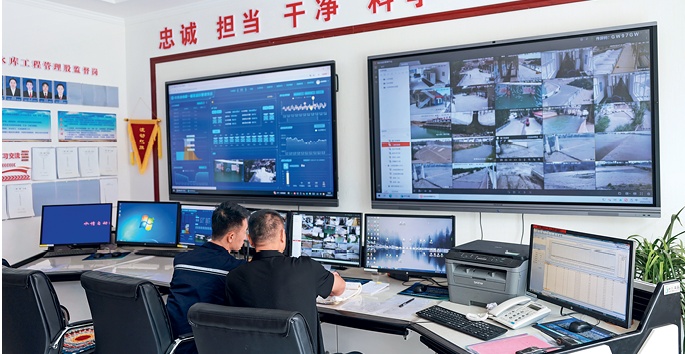
Staff at the Yuanyangchi Reservoir in Jinta County, Jiuquan City of Gansu Province closely monitor the changing hydrological conditions and report water levels, storage volume, and other key parameters in a timely and accurate manner on July 15, 2025.
 How Should Cities “Withstand It All?”
Engineering projects are being scaled up, and defense lines reinforced. But when a once-in-50-year rainstorm now strikes every three to five years and extreme weather becomes increasingly unpredictable, how exactly can cities withstand it all?
At the end of 2024, the General Offices of the CPC Central Committee and the State Council jointly issued the Guidelines on Advancing New Urban Infrastructure Development to Build Resilient Cities, calling for the creation of resilient cities characterized by strong adaptive capacity and rapid recovery.
According to Zou Liang, a resilient city has three defining features: robustness, recoverability, and adaptability.
Robustness refers to a city’s resistance to disasters – the ability to keep critical lifelines operational under design-standard hazards. Recoverability is the ability to quickly return to normal after a shock. Adaptability means dynamically optimizing urban development in response to external shocks and continuously adjusting to long-term changes such as climate change, the northward shift of rain belts, and the heat island effect.
Zou conceded that resilience does not mean simply pursuing ever-higher engineering design standards. “If you build to a once-in-100-year standard, what happens when a once-in-1,000-year event hits?”
In his view, engineering measures inevitably have objective limits. One must account for economic cost constraints and the realities of urban development. It is simply unrealistic to pour unlimited investment into infrastructure for low-probability, extreme disasters.
Taking the pressing issue of extreme rainfall as an example, Zhang argued that flood control must evolve on three fronts: from draining rainwater to managing rainwater – slowing it down, retaining it, and letting it infiltrate to reduce peak flow; from single-facility design to systematic resilience design; and from recurrence intervals to climate-adaptive dynamic defense standards – leaving room for future climate change. 
ZHANG YAN is a reporter with China Economic Weekly.