To truly appreciate the vastness and multiculturalism of China, it is essential to travel to the Xinjiang Uygur Autonomous Region in the country’s northwest – at least once.
It was my third visit as I made my way from the economic and commercial hub of Guangzhou to Xinjiang’s regional capital city of Urumqi, a journey of around 5.5 hours by domestic flight.
Xinjiang’s area of 1.66 million square kilometers covers one-sixth of China’s territory and supports a population of 25 million.
A Mosaic of Peoples
A defining feature of Xinjiang is its multicultural character, home to more than 50 ethnic groups, the largest being the Uygurs, who make up 45 per cent of the population.
The Uygur ethnic group in Xinjiang has been formed through a long process of migration and integration, and many different names were used in historical records to refer to this group of people. Monuments and places of worship belonging to various religions are scattered throughout the region, ranging from Islamic minarets and Buddhist temples, to Christian churches. This multiculturalism and the coexistence of many ethnic groups have shaped the region’s distinctive cultural identity.
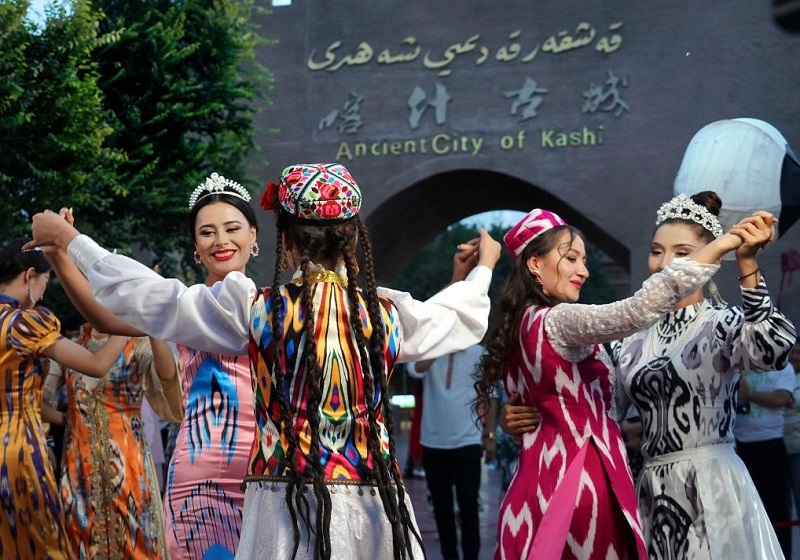
Uygur people dance at the entrance to the Ancient City of Kashi.
A Gateway Between Civilizations
Xinjiang serves as China’s gateway to the outside world, as it borders eight countries: Russia, Mongolia, Kazakhstan, Kyrgyzstan, Tajikistan, Afghanistan, Pakistan and India, along a frontier stretching 5,700 km. In ancient times, the Silk Road crossed the region. Today, this famous route has been transformed into China’s Belt and Road Initiative, a vast global cooperation drive, focusing on promoting policy coordination, infrastructure connectivity, unimpeded trade, financial integration, and people-to-people bonds, with the aim of bringing benefits to all participating countries. Due to its geographical location, Xinjiang appears to continue to play a prominent role in advancing China’s outward-looking policies. Proof of this is the recent 9th CHINA-EUROASIA EXPO, which saw the participation of 49 countries.
The topography is equally defining. Covered mainly by steppes and desert with scarce rainfall, the region depends heavily on meltwater from winter snow. Temperatures can swing from minus 50 degrees Celsius in winter to 50 plus in summer.
And yet, against all odds, a thriving agricultural sector has emerged, powered by impressive water-management and irrigation techniques. Nowhere is this more striking than in Xinjiang’s grape and wine production. Because of the harsh winters, vines are buried under soil each autumn to protect them until spring. While irrigation and frost management make viticulture exceptionally demanding, the results speak for themselves: Xinjiang wines claimed 49 medals at the 2026 Decanter World Wine Awards.
From Desert to Oasis
The most astonishing undertaking in Xinjiang is the ecological greening and stabilization of the desert’s edge, preventing the Taklamakan – the world’s second-largest mobile desert – from expanding further into surrounding oasis farmland. The crown jewel is the encirclement of the Taklimakan Desert by a 3,046-kilometre sand-blocking green belt, forming the world’s longest ring-shaped desert green ecological barrier. Along significant stretches of the perimeter, solar panel arrays are installed to stabilize the sand and reduce wind speed, while hardy drought-tolerant plants are cultivated beneath and between the panels using innovative techniques.
Between 2012 and 2024, forest cover increased from 4.24 percent to 5.07 percent of the region’s total area. The average rainfall has shown a steady increase because of these initiatives, and other oasification measures taken.
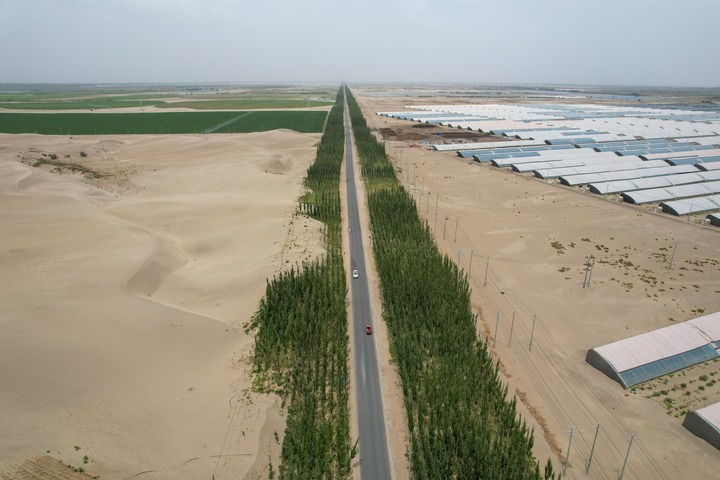
Shelterbelt in Hotan County, Xinjiang, flanked by desert forage production bases and protected agriculture facilities.
Xinjiang’s economy extends far beyond agriculture, reaching deep into minerals and natural gas. Alternative energy is particularly well developed: the region hosts the Midong solar farm, the world’s largest single-unit photovoltaic plant, with a capacity of 3.5 GW. When it comes to environmental protection, comparatively speaking, the Chinese talk less but do more, having demonstrably made the greatest contribution to natural-environment preservation in recent years.
Xinjiang through European Eyes
Xinjiang is frequently accused in many Western media outlets of human-rights violations against the Uygurs. The stance of the U.S. and the EU on this matter appears driven by political and other considerations, and is not substantiated to a degree that would justify sanctions.
In fact, the Uygur ethnic group is growing rapidly in terms of population, compared with other ethnic groups. Uygurs hold high-ranking positions in government and other public offices, such as regional governor and mayor of the capital, as well as other important posts. Meanwhile, Xinjiang’s economic growth rate exceeds that of China as a whole (5.5 per cent compared with 5 per cent), whilst there is a clear improvement in the quality of people’s lives.
The central government and the Communist Party of China have continued to attach particular importance to Xinjiang in recent years, providing financial and other forms of support to the region.
Here in Cyprus, we regrettably follow the policy of our European partners. Our one-sided orientation towards NATO and the U.S. helps neither the Cyprus issue nor the Cypriot economy. Our relationship with China needs to be mutual and sincere, based on the national and broader interests of our country, rather than superficial and subordinated to the interests of third parties.
NIKOS IOANNOU is a member of the Central Committee of the Progressive Party of Working People (AKEL) of Cyprus.