On July 23, 2026, a Chinese and foreign media delegation participating in the “Together on the Long March: 90th Anniversary of an Epic Journey” international communication project arrived in Wuqi County of Yan’an City in northwest China’s Shaanxi Province. At the Wuqi Revolutionary Memorial Hall, the Central Red Army Long March Victory Memorial Park (Monument), and the Wuqi Afforestation Exhibition Hall, journalists retraced the footsteps of history and learned about the profound transformation of the county from a barren land that often suffered from sand storms to a region covered with lush greenery.
David W. Ferguson, a recipient of the Chinese Government Friendship Award and honorary chief English editor of the Foreign Languages Press, said the trip gave him a much deeper understanding of the Long March. Although he had previously learned about the history through editing books on the Communist Party of China (CPC), visiting the sites in person offered a far more vivid experience.
He likened his previous knowledge to “a jigsaw puzzle with a missing middle section.” The trip, he said, enabled him to touch the texture of history and fill in those gaps. Visiting these historical sites in person, he noted, provides a much more vivid and direct way of understanding the major events that unfolded during the Long March. “The Long March was a seminal event in contemporary history, not just for China, but for the world,” he said.
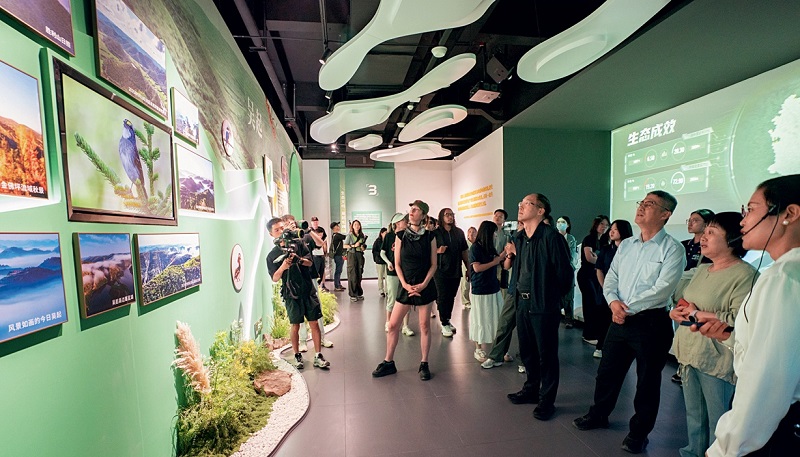
A joint Chinese and foreign media delegation from the “Together on the Long March” international communication project visits the Wuqi Afforestation Exhibition Hall on July 23, 2026. Yang Jia
The Red Long March: From History to the Present
On October 19, 1935, after enduring tremendous hardships, the CPC Central Committee led the Central Red Army to Wuqi Town, where it joined forces with the Red Army in northern Shaanxi. Wuqi subsequently became a foothold for the CPC Central Committee and the Central Red Army, serving as a base for defending and expanding the northwest soviet area and advancing the Chinese revolution from one victory to another.
Local people warmly welcomed the Red Army, offering grain and slaughtering pigs and sheep to support the soldiers. The deep bond between the army and the people became one of the most moving chapters in the history of the Long March.
On October 18, 1935, Mao Zedong led the Red Army to Zhangwanzi Village in Wuqi County, where he stayed overnight at the home of a villager named Zhang Tingjie. Zhang and his wife brought out their treasured mutton and prepared mutton buckwheat noodles, a dish traditionally reserved for festivals and special occasions. Mao ate three large bowls and exclaimed, “It’s very delicious! I haven’t had such delicious food during the one year of the Long March. Northern Shaanxi is a good place!”
The bowl of buckwheat noodles with mutton symbolized the deep ties between the people of northern Shaanxi and the Red Army and reflected a defining feature of the CPC: its deep roots among the people and close ties with them. It is precisely because the CPC has always remained rooted in and relied on the people that it has been able to continually draw strength to advance throughout more than a century of endeavors.
At the Wuqi Revolutionary Memorial Hall, Elsbeth van Paridon, a Dutch sinologist and editorial consultant at Beijing Review, visited the cave dwellings where Mao Zedong and other revolutionaries once stayed, as well as the kitchens, bridal chambers, and other cave spaces in local homes where Red Army soldiers had lodged. She was particularly drawn to these preserved historical spaces because they bring to life the history of the revolution, making it more tangible than what can be conveyed in books alone.
Van Paridon paid particular attention to the historical information embodied in revolutionary artifacts. She noted that seemingly ordinary items such as straw sandals, military uniforms, and backpacks record the hardships and difficulties endured by the Red Army during the Long March, while also spark people’s interest to learn more about this period of history.
In her view, the values embodied in the spirit of the Long March – sacrifice, perseverance, and struggle – transcend national borders and historical eras. Although countries and peoples have different historical experiences, stories of faith and perseverance resonate universally.
Citing the history of World War II in Europe as an example, she pointed out that people around the world similarly admire sacrifice, courage, and perseverance when reflecting on pivotal moments in their own histories. In this sense, she said, the Long March belongs not only to the China’s historical memory, but also carries broader human significance.
In her view, the spirit of the Long March should not be limited to the traditional perspective of military victory. Instead, it can be regarded as one type of “living heritage.” Today, many former revolutionary sites have become venues for promoting red culture, attracting visitors to experience and learn about history while also contributing to local economic development. This, she said, demonstrates the contemporary value of historical heritage.
She believes this is the best way to commemorate the revolutionary martyrs. “If the Red Army soldiers who sacrificed their lives back then could see that the places where they once fought and made sacrifices have today prospered because of this history, they would surely feel comforted,” she said. “Their sacrifices have brought happiness to future generations.”
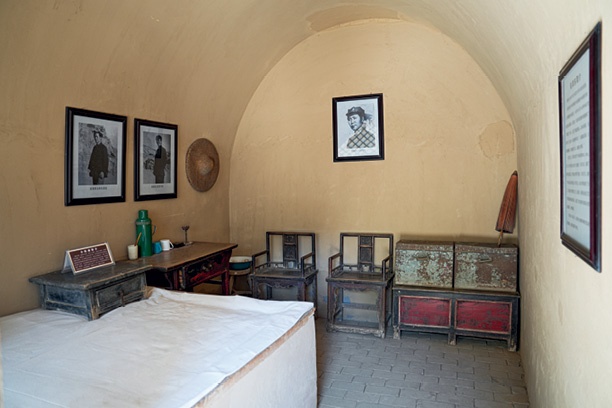
Mao Zedong’s former residence at the Wuqi Revolutionary Memorial Hall. Huang Yuhao
The Green Long March: From Barren Hills to an Oasis
If the red Long March left behind a legacy of steadfast faith and perseverance, the green Long March is writing a new chapter of harmonious coexistence between humanity and nature in the new era.
Located in the heart of the Loess Plateau, Wuqi once suffered from a fragile ecosystem and severe soil erosion. In 1997, the county had 3,702.9 square kilometers affected by soil erosion. Forest coverage stood at only 6.5 percent, while combined forest and grassland coverage was 19.6 percent. The county experienced an average of 19 sandstorms annually, making it one of the regions most severely affected by soil erosion in the middle and upper reaches of the Yellow River. At the time, Wuqi had fallen into a vicious cycle: increased cultivation led to greater poverty, which in turn drove further land reclamation; overgrazing accelerated desertification, while worsening desertification encouraged even more grazing.
Faced with mounting ecological pressure, Wuqi began exploring a development path that was based on harmonious coexistence between humanity and nature. In 1998, the county became one of the first places in China to implement a project to close off mountains to grazing and prohibit free-range livestock herding, while returning farmland to forests. Through a series of measures, including returning farmland to forests, planting trees and grass, raising sheep in pens, and carrying out watershed management, the county promoted sustained improvements in its ecological environment.
Over the following decades, the once-barren hills gradually became green, marking a historic transformation of the Loess Plateau from “yellow” to “green.” By 2024, the area affected by soil erosion had fallen to 1,941.81 square kilometers, while forest coverage had risen to 20.3 percent and forest and grassland coverage to 72.9 percent. The average annual number of sandstorms had dropped from 19 to five.
Ecological improvement has also transformed the county’s development model. Wildlife has steadily returned, improving regional biodiversity, while green development has generated substantial economic and social benefits. In 2024, the ecological value created through Wuqi’s reforestation efforts reached RMB 3.474 billion, while farmers’ per capita disposable income increased more than twentyfold compared with 1997.
Zhavier Harris, a marketing and communications manager at Springfield Urban League in the United States, was deeply impressed by Wuqi County’s transformation. After visiting the Wuqi Afforestation Exhibition Hall, he said that the “green culture” Wuqi has developed today is rooted in its “red culture.” During the Long March, Red Army soldiers fought with their lives for a brighter future. Today, the achievements in ecological conservation represent a continuation of that aspiration in the new era.
German scholar Nils Bergemann viewed Wuqi’s ecological transformation from the perspective of its governance model. He believes that the success of returning farmland to forests was not achieved through the efforts of any one individual, but through strong cohesion and broad public participation. This spirit of working toward a common goal also echoes the unity and solidarity of the Red Army during the Long March.
“Whether it is the Long March or ecological restoration, both are long-term endeavors oriented toward the future,” Bergemann said.
In his view, Wuqi’s ecological governance is not an abstract concept, but the result of a series of concrete actions: reducing soil erosion, restoring vegetation, improving water systems, and developing green industries. These efforts have ultimately translated into tangible results, including the growth of tourism, improved living standards for residents, and sustainable regional development, turning lucid waters and lush mountains into real invaluable assets that benefit local people.
Bergemann believes Wuqi’s green practices offer useful experience for ecological restoration around the world, particularly in long-term planning, community participation, and sustained action. Ecological governance, he noted, requires looking beyond short-term gains and taking responsibility for future generations. In this sense, Wuqi’s experience offers a microcosm of China’s approach to governance.
Times change and missions evolve, but the spirit of perseverance among Chinese Communists has remained unchanged. The CPC has moved with development tide, always standing at the forefront of the times. From the Red Army’s Long March during the revolutionary years to the green Long March of ecological civilization in the new era, Wuqi represents not merely the transformation of a county, but also the passing on of a spirit across time and generations.
As the story of this land unfolds, the enduring spirit of the Long March will continue to illuminate the way forward.