At the southern end of Beijing’s central axis lies the world’s largest and best-preserved ancient imperial complex dedicated to the worship of heaven – the Temple of Heaven. It served as the site where emperors of the Ming (1368-1644) and Qing (1616-1911) dynasties performed spiritual rituals to worship heaven and pray for timely rain that would bring good harvests.
Originally built in 1420, the complex has undergone a number of expansions and renovations over the years. Now covering nearly three million square meters, it is around four times the size of the Forbidden City. Circular in the north and square in the south, the site symbolizes the ancient Chinese belief “round heaven and square earth.”
Over the past 600 years, it has witnessed more than 600 grand worship ceremonies conducted by 22 emperors. Today, as a historical site and an urban park, it attracts more than 20 million visitors each year, including international dignitaries. In 1998, the Temple of Heaven was inscribed on the UNESCO World Heritage List. In 2024, the “Beijing Central Axis” was also added to the list, with the Temple of Heaven included as one of the 15 sites located along the Axis.
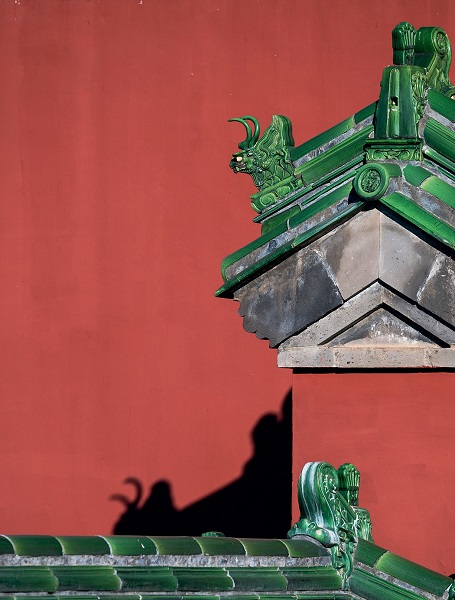
A close-up view of the ancient building roofs at the Temple of Heaven.
Prayer for Good Harvests
The ornate Hall of Prayer for Good Harvests is one of the most iconic structures in the complex. During the Ming and Qing dynasties, this was where emperors performed rituals in the first lunar month to pray for favorable weather to reap rich harvests. The plaque bearing its name at the entrance was inscribed by Emperor Qianlong.
The presiding wooden edifice rises up on a six-meter-high, three-tiered white marble platform. The hall is about 38 meters tall and 24 meters in diameter. Its three-tiered, blue-tiled circular roof is supported by layers of dougong (interlocking wooden brackets) and resembles three enormous stacked-up umbrellas. A gilded finial crowns the roof and ornate decorations painted on the exterior add to its splendor.
Back in 1420, the site was occupied by a rectangular hall where heaven and earth were worshipped together. In 1545, it was rebuilt in its present form, with blue, yellow, and green glazed tiles covering the three levels of the roof from top to bottom, symbolizing heaven, earth, and all beings respectively. In 1751, the roof was changed to blue glazed tiles, and the building was renamed to what it is known as today.
Its three-tiered circular roof is one of a kind among ancient Chinese buildings that still stand today. This unique design creates a sense of openness yet requires demanding architectural skills. The structure is supported by three rings of large pillars, connected not only by commonly-used straight beams but also by numerous curved beams meticulously shaped with chisels, saws, and planes. More than 200 interlocking wooden brackets are arranged between the layers of the roof, serving both structural and aesthetic functions.
Inside the hall, visitors are greeted by richly ornamented pillars, beams, and a stunning ceiling. A highlight is the circular caisson ceiling, formed by layers of radially arranged bracket sets. At its center, a lifelike dragon and phoenix are depicted, which are auspicious symbols in traditional Chinese culture, signifying good fortune and representing imperial privilege. Amazingly, the pair of auspicious creatures on the ceiling is mirrored by another naturally formed pair in the stone floor directly beneath it.
The circular arrangement of the pillars inside the hall embodies the ancient Chinese concepts of time, space, and the cosmos. The four innermost pillars symbolize the four seasons. The 12 slightly thinner pillars surrounding them represent the 12 months of the year, and another 12 pillars farther out the 12 traditional divisions of the day. Together, the inner and outer pillars number 24, symbolizing the 24 solar terms. The hall has 28 pillars in total, representing the 28 Mansions (equatorial constellations in Chinese culture) in the night sky.
It is as though the myriad phenomena in the heavens are encapsulated within this small dome. It seeks to create a sense of the infinity within a finite space, making visitors feel like they are immersed in the boundless universe and experiencing the passing of time and the movement of the cosmos.
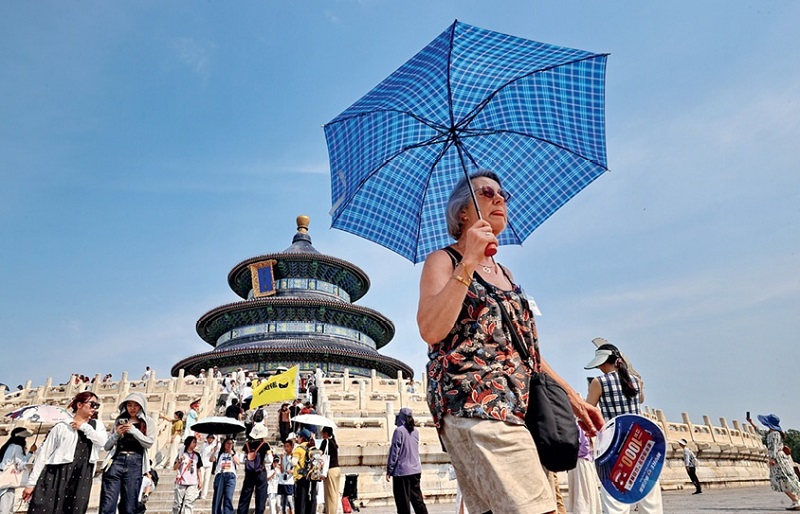
Visitors at the square of the Hall of Prayer for Good Harvests at the Temple of Heaven.
Worship of Heaven
The Circular Mound Altar was the principal site where ancient Chinese emperors worshipped heaven on the Winter Solstice. First built in 1530 and rebuilt in 1749, the altar consists of three tiers, with a maximum diameter of about 54.9 meters and a total height of about 5.2 meters.
Unlike other buildings in the park, the huge altar is an open-air structure – no walls, no pillars, and no roof. Instead, merely an austere platform stands exposed beneath the heavens.
Yet this extreme simplicity embodies the reverence for the number nine which was deemed as a supreme figure by the Chinese in antiquity: the paving stones on each tier are arranged in nine concentric rings, with the number of stones in each ring being a multiple of nine, and each flight of stairs having nine steps.
The roots of the circular form of the altar can be traced back more than 5,000 years, as evidenced by the archaeological discoveries at the Niuheliang site in northeast China’s Liaoning Province, reflecting a continuous tradition of reverence for the heavens. This type of worship arose from the practical needs of an agrarian society. The ancient Chinese believed that the heavens observed all human deeds, rewarding or punishing people through good weather or natural disasters.
This also explains why the Temple of Heaven contains a band of specially designed acoustic phenomena. Echoes could create an auditory illusion, making people feel as though they could truly communicate with heaven and earth. These ingenious acoustic features reflect the ancient Chinese aspiration to engage in dialogue with the universe.
As the most important site for worshipping the heavens, the Circular Mound Altar also features a special acoustic design. At the center of the uppermost tier lies a flat, cylindrical stone known as the Heart of Heaven.
When a person stands on it and speaks, sound waves are reflected by the smooth stone surface and the surrounding balustrades, with much of the sound returning to its point of origin. Because the altar is relatively small, the reflections take less than a second. When they overlap with the original sound, they make the voice seem unusually loud and resonant. When ancient emperors performed rituals here, it was as though they were communicating with the deity of the heavens, creating an air of divinity and solemnity.

A visitor practices the art of Tai Chi sword on the grounds of the Temple of Heaven.
Conversing with Heaven
The Echo Wall is a showstopper in the complex. This circular enclosure wall is known for its remarkable acoustic properties. It was built with tightly fitted bricks; its bricks are dense and hard, its surface smooth as a mirror, and its circular curvature exceptionally precise – all of which facilitate the reflection of sound waves.
At the Echo Wall, even two people standing dozens of meters apart can hear each other clearly even if they are speaking barely louder than a whisper. The ancient craftsmen created an acoustic marvel when they built the wall, allowing the “voice of heaven” to echo here and adding a touch of mystery to the solemn rituals.
On the main passageway connecting different sites sits the Three-Echo Stone. Clapping one’s hands before it produces three distinct echoes. This is said to vitalize the ancient belief that the words spoken by people on earth are heard by the gods who dwell in the heavens clearly – in other words, the gods observe all human deeds and words.
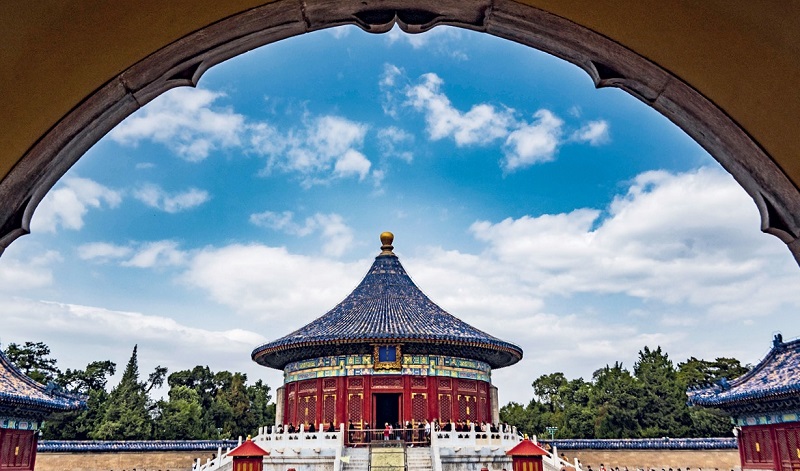
The colorful structures of the Temple of Heaven are accentuated by a backdrop of blue sky and patches of clouds.
National Unity
To the southeast of the Hall of Prayer for Good Harvests stand eight mountain-shaped carved stones, known as the Seven-Star Stones. There were originally seven stones here, symbolizing the seven peaks of Mount Tai, a sacred mountain range in China, and expressing a wish for the enduring protection of the imperial realm.
After the Qing Dynasty established its rule over China, an additional stone was placed to the northeast of the original seven to demonstrate that the Manchu people were also part of the Chinese nation. The addition conveyed a political message of “a united Chinese nation as one family.”
From the numerical symbolism and the allegory of time, to the acoustic marvels and icons of unity, every structure at the Temple of Heaven allows visitors to take in the beauty of Chinese architecture and dive in the timeless legacy of ancient Chinese cosmology and philosophy.