Founded in 1952, the Shanghai Museum is one of China’s most visited museums, drawing visitors with more than 1.02 million cultural relics, especially its exceptional collections of bronzes and traditional Chinese paintings and calligraphy.
A Millennia-Old Inscription
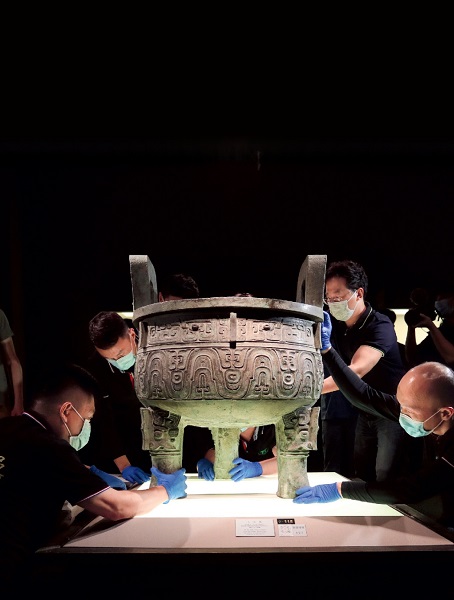
In the center of the museum’s bronze gallery stands a one-meter-tall Western Zhou (1046-771 B.C.) bronze vessel called Da Ke Ding, a crown jewel of the collection. Due to its significant historical value, it is prohibited from being exhibited overseas.
What makes the item so unique is an inscription of 290 Chinese characters on its inner wall, recounting the appointment and rewards bestowed by a Zhou king upon a nobleman named Ke. It provides rare historical evidence for the study of Western Zhou politics, official institutions, ritual practices, and land systems. The vessel also exudes majestic aura from its bold motifs and esoteric design.
During the Zhou Dynasty (1046-256 B.C.), ding was widely used in ritual ceremonies and recognized as a symbol of political power and social rank. A set of rules was even established prescribing the number and specifications of such vessels that nobles of different ranks could use, reflecting the hierarchical order at the heart of the Zhou ritual culture.
Beyond its craftsmanship, the draw of this ding stems from a series of anecdotes. In the chaotic late-Western Zhou period, it was buried underground to protect it from destruction. After a sound 2000-year sleep, it was unearthed in late Qing Dynasty (1616-1911), and was then soon acquired by collector Pan Zuyin. Unfortunately, it was buried again in the 1930s and 40s during the war of resistance against Japanese aggression. After the founding of the People’s Republic of China in 1949, Pan’s descendants donated it to the state.
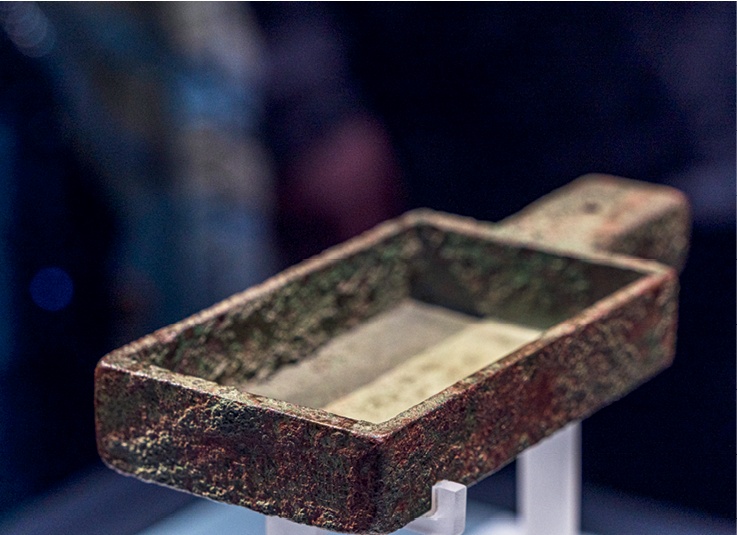
The Shang Yang Rectangular Sheng on display at the Shanghai Museum.
Melodious Ritual
If the Da Ke Ding speaks of the political order of the Zhou Dynasty, the Bells of Marquis Su of Jin brings its rituals and musical culture to life.
The set consists of 16 yong (meaning shank) bells, 14 of which are housed at the Shanghai Museum and two at the Shanxi Museum. A total of 355 characters were found inscribed on these bells, recording the military campaign of Marquis Su of Jin alongside King Li of Zhou, as well as Su’s achievements and rewards. These inscriptions prove to be vital for the study of Western Zhou history and chronology.
The bells can produce a wide range of tones. Different parts of each bell generate different pitches when struck, allowing the 16 bells to form a complete musical scale. Bird motifs on the side indicate where the bells should be struck. The “bird” tones are crisper than those produced from the front, resembling the singing of birds.
This bronze musical instrument offers us a glimpse into the vibrant ritual and musical culture of ancient China.
Qin’s Measure
Another showstopper at the museum is a seemingly modest but historically important bronze object – the Shang Yang Rectangular Sheng (standard measure). Only about the size of a palm, the vessel played a crucial role in the standardization of weights and measures under Shang Yang’s reforms in the State of Qin in the 4th century B.C.
Shang Yang, a Qin official and philosopher, initiated a series of legislative and administrative changes that transformed Qin into a powerful state and paved Qin’s way for the eventual unification of China.
Two inscriptions make this object extraordinary. Though lying not far from each other, they were inscribed 120 years apart, one in the Warring States period (475-221 B.C.) while the other during the Qin Dynasty (221-206 B.C.).
The first inscription shows that the item was cast in 344 B.C., and Shang Yang was the official responsible for designing it and supervising its production. Its capacity was one sheng (approximately 202.15 milliliters).
The second on the bottom states that in 221 B.C. Qinshihuang (the First Emperor of China) wiped out all other states and applied standardized weights and measures throughout the newly unified empire.
Before standardized units were established, people in China often relied on rough methods of measurement. For example, the amount that fit in both hands was considered one sheng. Such practices inevitably produced discrepancies, not only between different states but even among households within the same state.
The standardization of measures brought greater consistency to land surveys, agricultural production, taxation, and the collection of grain. With these measures in place, Qin gradually built a powerful unified empire.
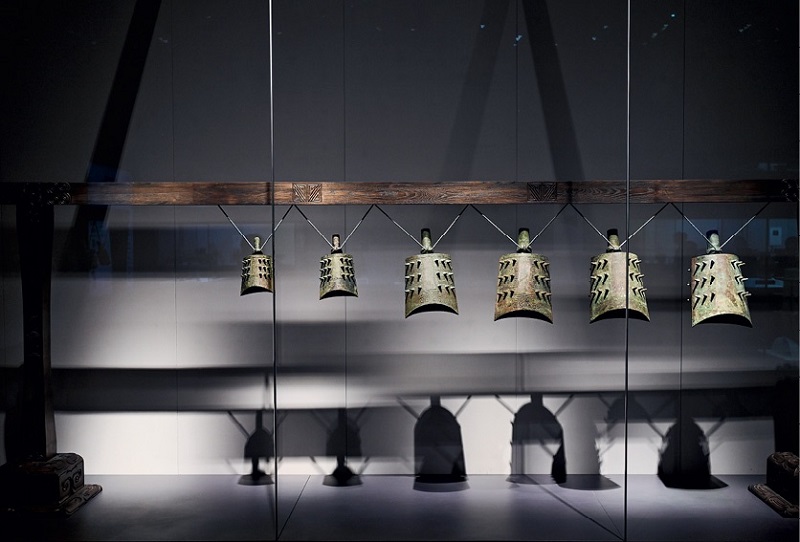
Some of the Bells of Marquis Su of Jin on display at the Shanghai Museum.
Age-Old Brushwork
The Shanghai Museum is renowned for its rich collection of traditional Chinese paintings and calligraphy. Among its most treasured works are the figure painting Recluses and the cursive calligraphy work Ku Sun Tie.
Recluses, the only surviving authenticated work by the late Tang painter Sun Wei (ca. 9th-10th century), depicts the famous story of the Seven Sages of the Bamboo Grove (a group of scholars and writers of the third century who chose spiritual freedom over political engagement during a chaotic era). Only four of the seven figures in the painting have survived today, yet their expressions, attire, and surroundings remain vividly rendered. The work is an important surviving example of Tang Dynasty (618-907) figure painting and offers insights into the evolution of figure painting from the Tang to the Song (960-1279) dynasties.
Tang Dynasty calligrapher Huaisu’s (737-799) Ku Sun Tie, by contrast, contains only 14 characters: a brief note inviting a friend to come and enjoy bitter bamboo shoots (ku sun) and tea. Despite its mundane subject, the work demonstrates the exceptional artistry of Huaisu, one of the greatest masters of kuangcao (wild cursive) calligraphy. His fluid, effortless brushstroke work and carefully controlled form reveal a perfect balance of both freedom and discipline.
Coveted by collectors throughout the centuries, the work bears many seals and inscriptions associated with successive imperial and private collectors, including renowned art-loving emperors Huizong of the Song Dynasty and Qianlong of the Qing Dynasty. Today, it is also one of China’s cultural relics prohibited from being exhibited overseas.
Lasting Legacy
Over the years, the Shanghai Museum has continuously refined its public education programs, building itself into an open classroom where people can learn about and experience Chinese culture.
The Ancient Civilization Exploration Center is a notable example. Designed for children and young people aged six to 18, it offers immersive experiences such as “Little Archaeologist,” “Little Conservator,” “Little Researcher,” “Little Curator,” and “Little Docent.” Through simulated archaeological digs, artifact conservation, and exhibition planning, young participants gain a firsthand understanding of how a museum works behind the scenes.
In addition, the museum organizes public lectures, art workshops, family reading sessions, study tours, and teacher-training activities around major exhibitions. Programs also extend museum education into local communities.
In recent years, the Shanghai Museum has further advanced its “Big Museum Plan,” establishing a “3+X” development framework centered on its East Branch, People’s Square Museum, and North Branch. It is also exploring the establishment of branches and “China exhibition halls” both in China and overseas. Through these efforts, the museum is exploring new ways for incorporating cultural heritage into contemporary life.
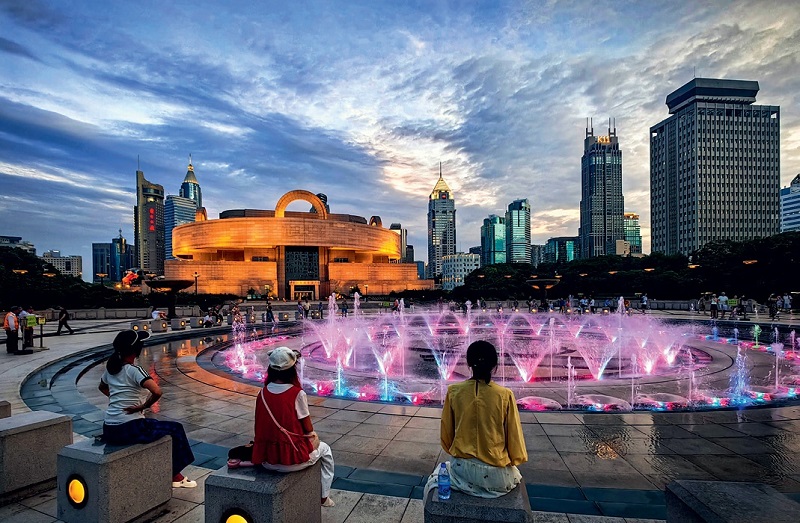
People take in the spectacle of a musical fountain outside the Shanghai Museum at sunset.