In today’s world of fleeting trends and fragmented content, serious literature is far from fading. Data shows that classic masterpieces and high-quality original works still occupy a solid share of China’s book retail market.
Take, for example, the People’s Literature Publishing House (hereinafter referred to as “PLPH”): Its various editions of the Chinese classic novel A Dream of Red Mansions have cumulatively sold over ten million copies. Moreover, the Chinese contemporary writer Liu Zhenyun’s latest novel, Salty Jokes, which the PLPH published at the end of last year, has already sold more than 700,000 copies.
At the same time, China’s online literature has burst onto the scene as a formidable force. With a readership of 600 million, it has become a veritable powerhouse for “new forms of literature and art for the general public in the internet age.”
On the occasion of the first-ever “National Reading Week,” China Today spoke with Zang Yongqing, president of the PLPH – China’s national-level professional literary publishing institution – about its practices in classic publishing, original works cultivation, and reading promotion, exploring how a literary publisher evolves, transforms, and fulfills its social responsibilities amid digitalization and shifting reading habits.
China Today: In an age defined by fragmented information and diverse entertainment options, in-depth literary reading faces significant challenges. As a national-level literary publishing institution, how does PLPH define its mission in this new era? What key adjustments has the Press made to its overall publishing strategy and direction to adapt to shifting readership habits and market challenges?
Zang Yongqing: PLPH’s mission is to publish the finest works of our time, particularly those that profoundly reflect contemporary social development and the lives of the people.
Admittedly, fragmented reading is a current trend. However, we are convinced that there remains a dedicated community of literature lovers who seek the most outstanding works of our era – they constitute our solid readership base.
While remaining committed to pure literature, we have also proactively expanded into genre fiction, particularly the print adaptation of top-tier online literature. In recent years we have launched such titles as Jiang Nan’s Dragon Raja, Mao Ni’s Ze Tian Ji and Qing Yu Nian, as well as Fenghuoxizhuhou’s upcoming masterpiece Xue Zhong Han Dao Xing. Having been phenomenal hits during their online serialization, these works gained a stalwart following among young readers who have unsurprisingly evinced keen interest in their print releases.
As readers’ tastes evolve, our publishing strategy adapts accordingly. Ultimately, readers’ demand defines the scope of our publishing services.
China Today: PLPH holds the copyrights to canonical classics ranging from A Dream of Red Mansions to The Complete Works of Lu Xun. Beyond traditional reprints, in recent years what innovative attempts have resurrected classic works successfully enough to attract younger readers?
Zang Yongqing: We have extensively explored the revitalization of classics, our core strategy being to develop multiple editions tailored to different audiences. Take A Dream of Red Mansions as an example: we offer a bestselling standard edition, a collectible hardcover edition, and a large-print version for elderly readers, along with a portable pocket edition and a special-edged edition for the younger demographic, as well as a guided reading edition for middle school students. We constantly refine our visuals to ensure that binding and layout designs align with contemporary aesthetic trends.
These reprints and new editions bolster our market stability. Last year, leveraging our vast repository of copyrighted works, we launched the pocket “Humanities Classics Library” series. Its release of 80 titles within the year achieved robust market success, sparking a pocket-sized paperback edition publishing boom across the industry. We adhere to the principle of selecting the best of the best, curating works from the canon of Chinese and world literature that possess enduring vitality and resonate most with current reader demands. Our goal is to integrate such classics into modern life in a lighter, more accessible way.
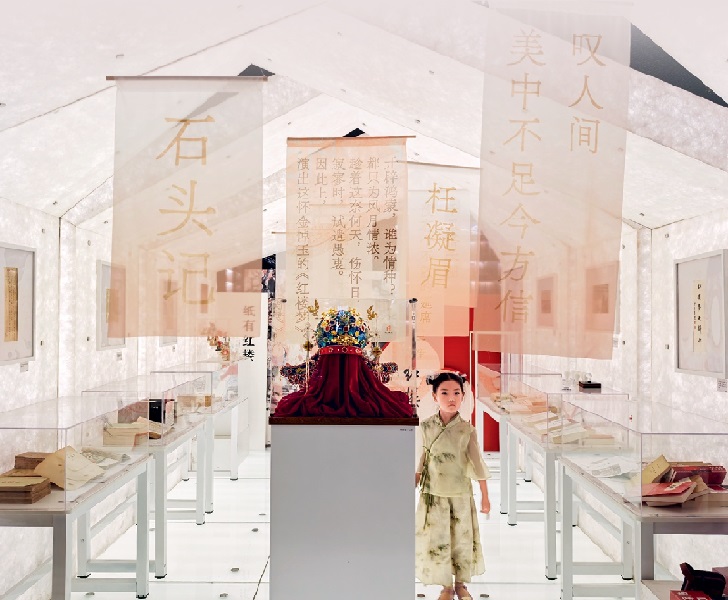
An exhibition at PAGEONE (Beijing Fang Store), hosted by the People’s Literature Publishing House from April 14 to May 14 in 2024, showcases archival materials on the publishing history of A Dream of Red Mansions.
China Today: In a pursuit-driven, fast-paced era, what kind of business logic is it that fuels publication and promotion of classic literary works that require deep, time-intensive engagement? How do you envision the relationship between printed books and e-books/audiobooks within the future reading ecosystem?
Zang Yongqing: As no publisher can publish every book under the sun, choices must be made. The focus of PLPH has always been anchored in literary classics – ancient and modern, Chinese and international. Our current priority is the multi-version, multi-format development of these core canonical works. Readership demand for classics, however, is relatively stable. Hence, with precise development strategies we can fully unleash the IP potential of these masterpieces. This market space remains vast, which is precisely why PLPH shuns the fleeting fads of fast-consumption culture.
Regarding the relationship between printed books, e-books, and audiobooks, I believe print sales have limited potential for further growth. Digital formats, therefore, constitute an excellent complement. Indeed, PLPH established a department for solely digital publications some time ago. Our revenue from these sectors has maintained an average annual growth rate of over 10 percent.
When we first ventured into audiobooks our aim was to embed QR codes into our physical books, thus enabling readers to both read and listen. But the main goal was to boost print sales rather than profit directly from the audio content itself. Today, however, our audiobook sales across multiple platforms are growing steadily and generating direct income and profits. Our current objective is to digitize our existing reservoir as comprehensively as possible in order for these classic works to reach audiences across different media forms.
China Today: What are PLPH’s plans in relation to AI empowerment in publishing and personalized reading services?
Zang Yongqing: As regards AI empowerment, our focus is on a systematic upgrade of the entire industry chain rather than limiting it to a single link. A comprehensive leap in efficiency through deep integration of AI into the whole publishing process – from editing and proofreading to layout design, and even short-video production for marketing – is our goal this year.
Our accelerated implementation of this plan will revitalize PLPH’s vast reservoir of content, and the deep integration we seek of technology and the classics will release the power of these timeless works.
China Today: Supporting original creation is the lifeblood of literary publishing. What unique mechanisms and practices does PLPH employ in discovering and nurturing new authors and works?
Zang Yongqing: During the past 75 years since its founding, PLPH has adhered to the principle of “valuing both established masters and emerging talents alike.” Beyond publishing the works of seasoned writers, discovering and cultivating promising new voices has been our constant editorial pursuit.
In the 1950s, Qu Bo, then an unpublished writer, authored Lin Hai Xue Yuan. After meticulous refinement whereby our editors worked closely with the author, the book ultimately became a canonical “red classic.” We continue to uphold this tradition today. The Press’s Party Committee has held multiple meetings geared to studying and formulating youth publishing support programs and establishing special funds to sponsor publications. We are convinced that today’s promising writers could well become the literary giants of tomorrow, and that the torch of culture must pass uninterrupted from one generation to the next.
In recent years, we have turned our attention ever more toward the works of tyro authors. Whether it be Wang Jibing, the deliveryman poet from Jiangsu Province, or Mao Jianjun, an oxygen technician at the Chaoyang Hospital in Beijing, their works, honed through deep collaboration with our editorial teams, have garnered warm responses upon publication. A television adaptation of Meishun and Changsheng is soon to be aired. Hua Luo Le, written by a worker at a Tianjin funeral parlor, has been reprinted five times, thus demonstrating the power of texts rooted in authentic experience. These works, rich with the texture of everyday life, have gained market recognition and strengthened our resolve to build platforms for expression, by and for the general public.
China Today: The proposals for the 15th Five-Year Plan advocate for “launching extensive public cultural activities, and promoting new forms of literature and art for the general public in the internet age.” What measures will PLPH take to focus on such “new forms of literature and art for the general public”? In the process of refining and canonizing online literature, what role does your editorial team play? And how do you balance the pace-driven nature of online literature with PLPH’s stringent literary quality requirements?
Zang Yongqing: Whether they be works in the category of “new forms of literature for the general public,” like Hua Luo Le, or top-tier online literature, once they enter PLPH’s publication waitlist, they must undergo a rigorous process of “refinement into literary excellence.”
We have always adhered to the tradition whereby editors must be responsible for texts and thoroughly refine the work. Regardless of the author’s fame, if an editor believes there is room for improvement, they will persistently push for revisions. This relentless pursuit of literary perfection is why our publishing pace is relatively slow.
The online literature we publish is already top-tier, yet our editors must nevertheless revise their structure, narration, and language. The same goes for writings by everyday people. Editors must communicate back and forth with authors until the work meets PLPH’s publication standards.
During the 15th Five-Year Plan period, we will launch a series for “new forms of literature and art for the general public.” Preparations are underway to create a “Long River Series” – an open-ended collection of individual books that are published as soon as they have been finished. Using this as a platform, we may keep discovering new literary talents and tyro authors, so bringing to the forefront the very best in new forms of literature and art for the general public.
China Today: PLPH has collaborated with NetEase Games’ Eggy Party on a publishing project. What is the underlying logic of this seemingly “dimension-breaking” crossover? Has it opened up new pathways for disseminating classical culture and developing original IPs? What other “publishing+” business modes will you explore in the future?
Zang Yongqing: This collaboration with Eggy Party is essentially a co-branded partnership. Combining the widely beloved “Eggy” characters with PLPH’s classic content is, in my view, a brilliant creative concept. More importantly, Eggy Party commands a massive user base, while PLPH’s classics have a solid readership foundation. By joining forces, we amplify both our cultural reach and market impact.
So far, this has proven a successful collaboration. Moving forward, we will pursue such co-branded and cross-industry partnerships with even greater enthusiasm.
As regards “publishing+”, PLPH’s cultural and creative merchandise business stands at the forefront of China’s publishing industry, wielding significant influence. For instance, in 2025, the “Lu Xun-style Woolen Vest” became a veritable sensation in the online cultural merchandise world, achieving over 200 million views in topic discussions and widespread acclaim.
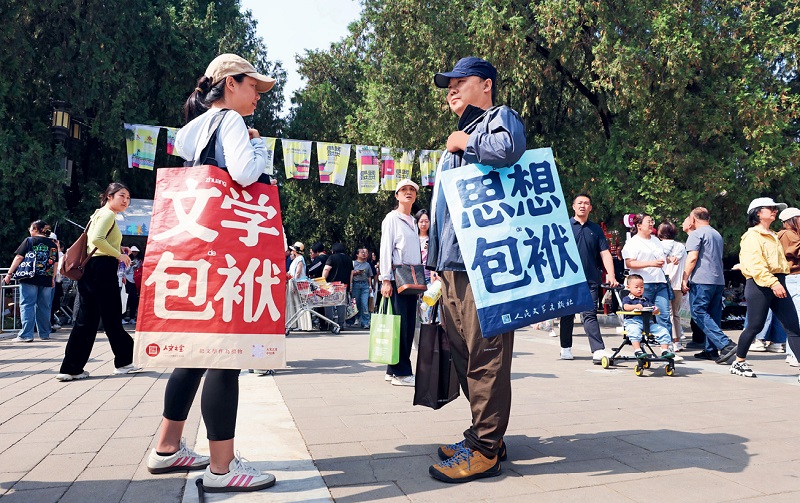
Tote bags with the words “Wenxue Baofu” (Literary Burden) and “Sixiang Baofu” (Mental Burden) sell very well at the Temple of Earth and Me book fair 2025 at the Temple of Earth Park in Beijing on September 21, 2025.
Another hit last year was the “Literary Burden” cotton tote bag. As can be seen in our bookstore downstairs, one side reads “Wenxue Baofu” (Literary Burden) and the other “Sixiang Baofu” (Mental Burden). It was incredibly popular. One elderly reader even waited in line for an hour and a half at Beijing’s Temple of Earth Park Book Fair just to get one.
Currently, we offer over 600 types of cultural products, maintaining a strong momentum. We also manage the Zhao Hua Xi Shi (Morning Flowers Gleaned at Dusk, title of a classic collection of essays by Lu Xun) chain of literary cafés. Our coffee is distinctive in featuring the images in latte art of renowned Chinese and foreign literary figures presented in blind boxes. Its taste is also excellent. Beyond our Beijing flagship, we have opened branches in Shaoxing, Handan, and Changchun, among others since April last year. During this year’s Spring Festival holiday, our Shaoxing (hometown of Lu Xun in Zhejiang Province) store, covering just over 100 square meters, achieved a single-day sales record of RMB 50,000 – a remarkable feat in the café industry. A second Shaoxing location is set to open soon. We plan to expand to other cities, including Chengdu, Shenzhen, Guangzhou, Suzhou, and Hangzhou.
Although these shops appear to be cafés, they function as hybrid bookstores. Beyond coffee, we prioritize sales of literary classics and hundreds of cultural products. Our localized approach is a key feature: wherever we open a shop, we include cultural merchandise unique to that locale, so integrating local cultural elements.
Our core strategy for cultural merchandise lies in the deep propagation of our own IP resources. I constantly emphasize staying true to our main mission. Whether the tote bags, the woolen vests, or “Guan Gong Socks” (Guan Gong being the martial god in Chinese folklore, of which we have sold 30,000 pairs), all originate in our rich literary IPs. Coffee bearing portraits of literary giants is another manifestation of this IP.
Furthermore, we transform books themselves into cultural products – such as by creating exquisite collector’s editions that replicate and aesthetically upgrade the original ones of the four great classical Chinese novels. All of this stems from our premium IPs while meeting the new demands of today’s cultural consumers.
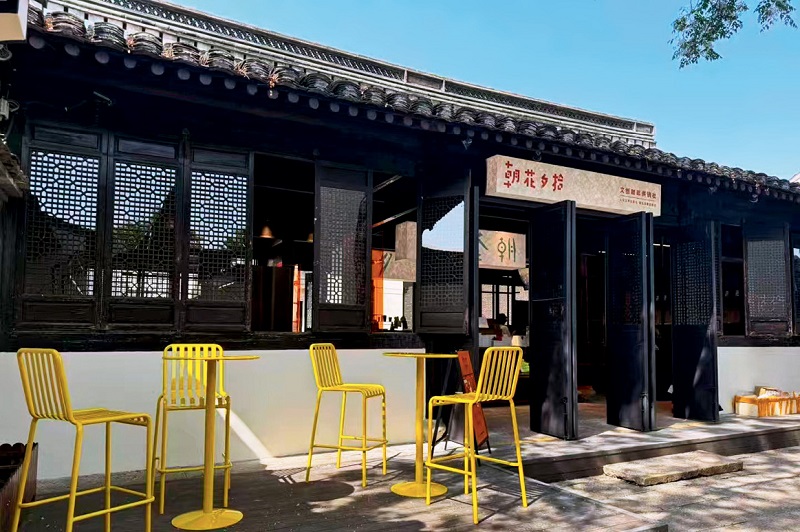
Zhao Hua Xi Shi (Morning Flowers Gleaned at Dusk) café in Shaoxing City, east China’s Zhejiang Province, is a sought-after spot for readers of the books of China’s revolutionary Lu Xun (1881-1936).
China Today: On the occasion of the first “National Reading Week,” how will PLPH leverage its role as the “national team” of the industry to lead the initiative? Will you launch any special events that allow readers of all ages and regions to experience the charm of literature?
Zang Yongqing: We have indeed prepared some scintillating events. First, on April 25 we will host the Contemporary Literature Awards Ceremony in Zhengzhou. This is the fourth consecutive year we have co-organized this annual flagship event with the Henan Daily Press Group. A stellar lineup of renowned writers, including Mo Yan, Su Tong, Chen Yan, and Bi Shumin, will attend.
This will be followed on the morning of April 26 by a Harry Potter themed event. This year marks the 26th anniversary of PLPH’s introduction of the Harry Potter series copyright. We will hold the event at the Guanghua Hall of the China Publishing Group International Publishing Exchange Center in Beijing, and invite over 500 young readers to participate in interactive sessions.
The highlight of the evening on the 26th will be the “Spring Blossoms: Hai Zi Poetry Appreciation and Reading Event” – a high-profile commemorative gathering. We have specially invited the esteemed scholar Xie Mian, well-known author Liang Xiaosheng, renowned poets Jidi Majia and Ouyang Jianghe, as well as celebrities from the arts circle like Hu Haiquan and Wang Yabin. Revisiting Hai Zi’s works through recitations is both a heartfelt tribute to the poet and a proactive response to the national reading campaign. This year saw our release of Kai Tou (The Beginning), a collection of Hai Zi’s previously unpublished novels that has drawn significant attention. Seizing the opportunity through this event to express appreciation is intended to honor the deep affection of our vast readership.
China Today: In an era of technological iteration, what is the core value of literary publishing?
Zang Yongqing: Great works and compelling stories. Because no matter how much our society has changed, the criteria for judging a great work remain the same. My greatest hope right now is that readers may allow themselves the quiet moments of serene focus to read – even if it means taking a year to finish just one book cover to cover. That would be wonderful.