
At the World Intelligence Expo 2026 in Tianjin, I emphasized in my speech the principle that should guide every conversation about artificial intelligence (AI) today, namely without transparent, responsible, and ethical governance frameworks, the transformative potential of AI would be undermined by fragmentation and mistrust. The world now stands at a crossroads. A unified global AI governance framework remains elusive, so the question is no longer whether the EU and China should cooperate, but where and how they can do so most effectively.
Complementary Capabilities, Converging Interests
The case for deeper EU-China cooperation in AI rests on genuine complementarity. The EU brings to the table world-leading expertise in AI-driven decarbonization, high-performance supercomputing, and regulatory governance, particularly in sectors like healthcare, where patient safety and data security are paramount. China, meanwhile, offers unparalleled industrial clusters, an unmatched ability to commercialize new technologies at speed, and a highly digitalized society that generates vast pools of real-world data for training AI models. China’s leadership in robotics, smart manufacturing, and the integration of autonomous vehicles within smart cities creates a natural synergy with European innovation.
This is not merely a theoretical alignment of capabilities. In practice, European firms can contribute advanced digital modeling and process optimization expertise, while Chinese partners provide the scale, data infrastructure, and manufacturing agility needed to bring those innovations to market. From tracing the environmental footprint of products with granular precision to identifying alternative, more sustainable materials, the scope for mutual value creation is enormous.
Where Joint Innovation Can Deliver Global Impact
Looking ahead to the next wave of AI-driven disruption, several areas stand out as particularly promising for joint innovation.
In R&D and design, AI is already being deployed at the molecular level to accelerate product development. Collaborative teams combining European in-depth research with China’s rapid prototyping capabilities could significantly shorten the path from laboratory to market.
In supply chain management, AI is revolutionizing how firms map their extended networks – both upstream and downstream. Real-time tracking of inventory, product quality, and demand patterns, combined with predictive analytics for anticipating shocks such as price spikes, offers a powerful tool for building resilience. For industries like chemicals, automobiles, and machinery, this represents a shift from reactive risk management to proactive, intelligent orchestration.
Most importantly, in green manufacturing and carbon neutrality, AI offers a pathway to reconcile industrial competitiveness with climate imperatives. The EU’s leadership in decarbonization optimization, paired with China’s manufacturing scale, could set new global benchmarks for reducing emissions across complex supply chains.
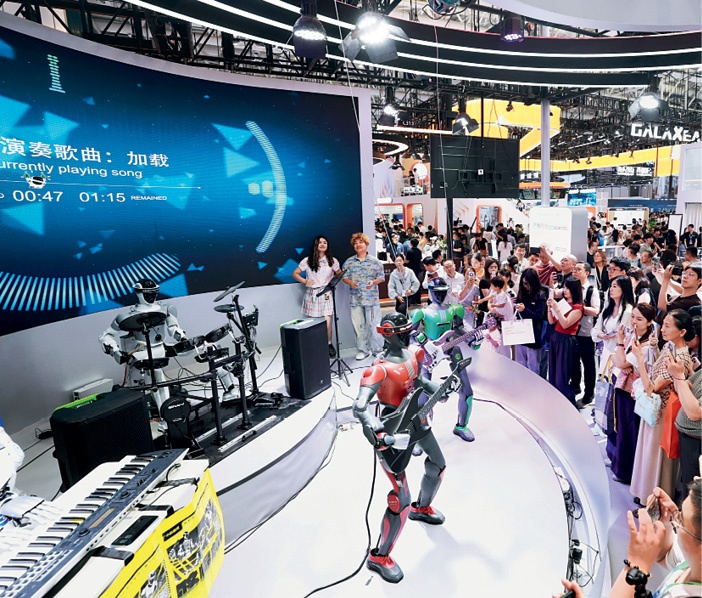
Attendees at the World Robot Conference 2026 watch a robot band performance on August 19, 2026.
Preventing a Fragmented AI Order
Technological complementarity on its own, however, is insufficient. The absence of aligned governance frameworks poses a serious risk of bifurcation, whereby two parallel sets of AI standards emerge, increasing costs for businesses and limiting the technology’s global reach.
It is encouraging, though, that both EU Member States and China are active in drafting international AI standards at institutions such as the ISO and IEC. But activity is not the same as alignment. To prevent a splintering of global norms, both sides must intensify their efforts to develop shared, interoperable AI standards and data security regulations that facilitate, rather than impede, the free flow of information used for legitimate business purposes.
This requires a delicate balance. Governance must be robust enough to ensure ethical use and protect citizens, yet flexible enough to avoid stifling the very innovation it seeks to guide.
Navigating Supply Chain Realities
The conversation about AI cooperation cannot be separated from the broader context of global supply chain restructuring. Growing geopolitical tensions have exposed the fragility of global sourcing and distribution networks. In response, many European companies have re-evaluated their strategies, taking steps to onshore or offshore portions of their supply chains to build resilience and mitigate risk.
Despite these adjustments, China remains an increasingly indispensable link in European supply chains. The challenge now is to maintain this integration while operating in what has become a more volatile environment. Companies must constantly monitor their exposure and be ready to adapt. This makes collaborative, AI-enhanced supply chain tools even more valuable.
For European companies pursuing “localized innovation” in China, the opportunities are substantial: access to a deep pool of highly talented researchers, collaboration partners, and the ability to commercialize and scale products at unprecedented speed. However, these advantages coexist with serious concerns.
Intellectual property protection remains a critical issue. While China’s written rules and regulations on IP are largely aligned with international standards, enforcement gaps persist. This has led some firms to adopt a bifurcated strategy: conducting R&D on widely commercialized technologies in China to leverage its innovation ecosystem, while keeping core technology development outside the country to mitigate the risk of IP leakage. Although it is a pragmatic response, it is not ideal. True partnerships require confidence that proprietary innovation will be protected.
The European Union Chamber of Commerce in China (European Chamber) is committed to serving as a bridge in this complex landscape. We will continue to facilitate dialogue between EU and Chinese policymakers, advocate for improvements to the business environment, and provide evidence-based recommendations, including through our annual Position Paper, to help both sides navigate the evolving AI landscape.
The future of AI will not be written by any single nation. It will be shaped by those willing to build governance frameworks that are as innovative as the technologies they regulate, and by partnerships that leverage complementary strengths rather than exploit competitive fears. The EU and China have both the opportunity and the obligation to lead this effort, starting with the standards, collaborations, and trust-building measures that can turn potential into progress. 
JENS ESKELUND is president of the European Union Chamber of Commerce in China (European Chamber).