As Sweden reboots its nuclear ambitions amid a fragile global economy, China offers the Nordics an opportunity to build long-term resilience in energy security and green technology.
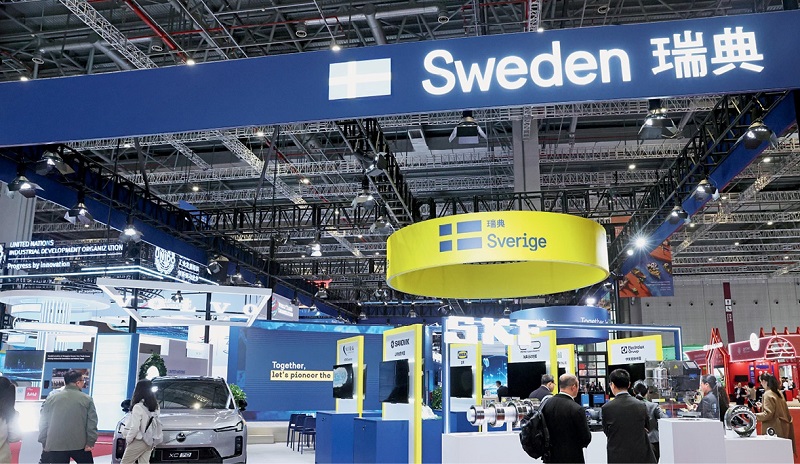
The 8th China International Import Expo (CIIE) opens at the National Exhibition and Convention Center in Shanghai, on November 5, 2025. The photo shows the Swedish pavilion at the CIIE’s Country Exhibition.
 When Chinese Foreign Minister Wang Yi wrapped up his six-day tour of Denmark, Sweden, Finland, and Norway on July 7, he didn’t just leave behind the customary joint statements of friendship – he also left an invitation.
Nordic policymakers would be wise to take it into serious consideration.
Wang met with Danish King Frederik X, Swedish Prime Minister Ulf Kristersson, Finnish President Alexander Stubb, and Norwegian Prime Minister Jonas Gahr Støre. In each capital, the two sides pledged to deepen cooperation in trade, green transition and technological innovation.
The timing could hardly be more consequential.
The world economy is navigating a period of exceptional difficulty. Trade frictions are rising. Energy markets, still scarred by years of disruption, remain fragile. And a quiet but mounting uncertainty is settling over the long-dominant role of the U.S. dollar in global finance.
Against that backdrop, China’s outstretched hand to the Nordic region is not a diplomatic pleasantry. It is an opportunity to build resilience precisely where the region needs it most.
A Partnership Already Bearing Fruit
Numbers tell their own story. In 2025, bilateral trade between China and Sweden reached US $19.37 billion, meaning Sweden remained China’s largest trading partner in the Nordic region. China-Denmark trade exceeded US $18 billion, with China remaining Denmark’s largest trading partner in Asia. China-Norway trade stood at US $11.41 billion, making China Norway’s largest trading partner in Asia, while China-Finland trade surpassed US $8 billion, with two-way investment stock topping US $23 billion. Total trade between China and the five Nordic countries reached US $53.17 billion in 2024, which means it is growing faster than the China-Europe average.
Electric vehicles and power batteries have emerged as new hotspots of cooperation, and both sides have capacity to deepen alliances in green shipping, biopharmaceuticals, the circular economy and digital governance, all areas that were specifically flagged for in-depth work during the July visit.
The two sides have also pledged to strengthen dialogue on global AI governance and to explore common rules in that field, a sign that cooperation is extending well beyond traditional trade goods into the technologies that will define the next stage of the relationship.
Denmark’s experience is instructive. The Green Joint Work Program (2023–2026) between the two governments, running since 2023, has already produced results in scientific research, green shipping and healthcare, and both sides have agreed to negotiate a new and upgraded version. It is a small but important example of how a formal framework, once built, tends to generate more cooperation rather than less.
None of this happened by accident. It is the product of decades of steady institution-building, and that history is worth revisiting.

IKEA China’s first store in Shanghai launches a “Green Living Festival,” on April 29, 2026, featuring a recycling market that gives secondhand furniture a new lease on life.

Sweden’s Energy Pivot Creates an Opportunity
Nowhere is this cooperation potentially more relevant than in energy policy.
Sweden is currently reassessing its long-term energy strategy, including a renewed emphasis on nuclear power. After decades of limited expansion following the country’s 1980 nuclear referendum, Stockholm has adopted a more favorable position toward new nuclear development in response to rising electricity demand, industrial electrification, and climate targets. Sweden has now set a roadmap targeting 2,500 MW of new nuclear capacity by 2035 and up to 10,000 MW by 2045. The state has agreed to take a 60 percent stake in Videberg Kraft, the company planning new reactors at Ringhals, and lawmakers have eased permit regulations to open the door to development beyond the country’s three existing sites.
This is a welcome and necessary step.
Nuclear power, alongside hydro, will remain the backbone of Sweden’s fossil-free ambitions.
At the same time, large-scale nuclear projects require long planning horizons, major capital investment, and complex regulatory processes. Even under optimistic scenarios, substantial new generating capacity is unlikely to arrive quickly. Sweden therefore faces a practical challenge familiar to many industrial economies: how to maintain energy stability and support industrial growth while long-term infrastructure projects are still under development.
This transitional period creates opportunities for complementary technologies, including grid modernization, energy storage, renewable integration, and industrial electrification – all sectors in which Chinese companies have developed significant manufacturing scale and technical expertise.
What China Can Offer, and What the Nordics Already Possess
China today possesses one of the world’s largest manufacturing ecosystems for renewable energy technologies, batteries, electric vehicles and grid-scale energy storage. For Nordic countries pursuing de-carbonization while safeguarding industrial competitiveness, these capabilities may offer practical advantages.
At the same time, the Nordic countries bring their own substantial strengths to the partnership: advanced engineering, strong research institutions, highly developed digital infrastructure, and globally competitive clean-technology industries.
Sweden in particular combines industrial capacity with abundant natural resources, including iron ore and several minerals important to battery and green-energy supply chains.
This is exactly the kind of resource-and-technology pairing that has powered much of the recent growth in China-Nordic trade, and there is little reason it could not extend into small modular reactor components, battery recycling, and next-generation grid materials as well. Cooperation in areas such as battery recycling, smart-grid technologies, green shipping, and low-carbon industrial materials could therefore prove mutually beneficial.
The key issue is not whether opportunities exist, but whether both sides can sustain pragmatic engagement despite broader geopolitical tensions and growing economic fragmentation internationally.
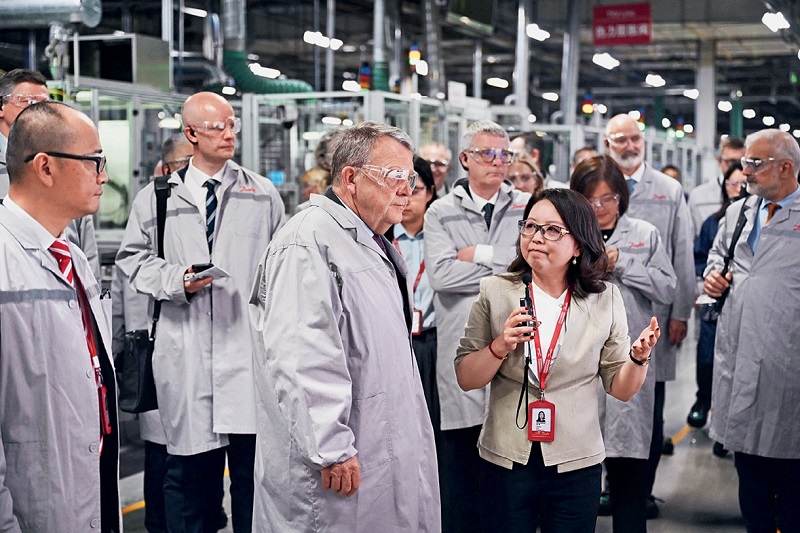
Danish Foreign Minister Lars Løkke Rasmussen visits the Danfoss factory in Tianjin, on May 18, 2025.
A Relationship Built Over Decades
The broader historical context also matters.
Sweden was the first Western country to establish diplomatic relations with the People’s Republic of China (PRC), in May 1950, a relationship now in its 76th year. Denmark and Finland recognized the PRC later the same year, and Norway followed in 1954.
Over the past 76 years, China and the Nordic countries have built extensive networks of commercial, educational, and diplomatic exchanges. China and Sweden signed an intergovernmental trade agreement as early as 1957. Their Joint Economic and Trade Committee has since met twenty times. Today, more than 600 Swedish companies maintain a long-term presence in the Chinese market, and nearly 10,000 Swedish firms trade with China in some form. IKEA is the best known one of them. In 2025, at the China International Import Expo in Shanghai, Sweden was named guest of honor, a recognition that marked the 75th anniversary of the two countries’ ties.
The commercial ties go back further still. More than two centuries ago, Swedish ships sailed to Guangzhou, now capital city of south China’s Guangdong Province, along the maritime trade routes and returned laden with silk, tea, and porcelain, a reminder that the exchange between these two nations long predates any modern political arrangement.
Over seven decades of engagement, which has transcended Cold War divides, changing governments, and a shifting global order, have left a foundation of institutional familiarity and mutual respect that newer partners simply do not have.
That history is an asset, and it ought not to be squandered at a moment when both sides have so much to gain from cooperation in green technology and energy security.
Looking Beyond the Present
The argument for sustained China-Nordic engagement ultimately extends beyond immediate commercial gains.
As governments confront rising protectionism, energy insecurity and uncertainty in the global economic system, diversified partnerships are becoming increasingly valuable. China has repeatedly emphasized support for multilateral trade and stable China-Europe industrial supply chains. Nordic countries, meanwhile, continue to seek reliable international partnerships capable of supporting green transition and long-term industrial competitiveness.
Naturally, concerns regarding technology standards, economic dependence, and national security remain part of the discussion. Those concerns deserve serious and balanced consideration. Yet strategic caution does not necessarily preclude constructive cooperation.
The larger question is whether Europe and China can maintain enough practical engagement to address shared challenges in climate transition, industrial modernization, and technological change.
Wang Yi’s visit, and the consensus reached with all four governments to uphold their bilateral partnerships, signals that Beijing sees the region as a serious long-term partner, not simply a market of convenience.
For the Nordic countries, the wiser course is to match that horizon. Plan energy security, industrial policy, and trade relationships not just for the next four or five years, but for the decades ahead.
Over seven decades of diplomatic relations do not guarantee future cooperation. But they do provide a foundation that many newer international relationships lack. At a time of global uncertainty, that foundation may prove increasingly valuable. 
THOMAS KARLSSON is a researcher with the Belt & Road Institute in Sweden.