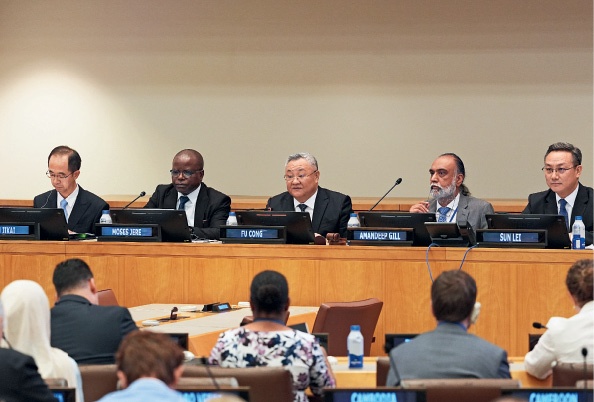
Amid deepening geopolitical fault lines, rising trade frictions, and diverging tech regulations, the China-Europe relationship is under tremendous pressure. As “de-risking” and “decoupling” dominate policy discourse, a fundamental question emerges: Can vastly different civilizations move beyond entrenched misperceptions and strive for genuine mutual understanding? Jeppe Søe, former deputy speaker of the Danish Parliament and a seasoned journalist, believes they must, and they can.
In a recent interview with China Today following his sixth visit to China, Søe shared firsthand observations from his traveling across China. He argues that the real crisis between China and Europe is not merely political or economic, but a deeper breakdown of human connection. On AI, he rejects the framing of competing governance models, for practical collaboration in areas such as healthcare and climate, where the cost of failure is measured in human lives. Søe’s ethos holds that leaders, businesses, and ordinary people can and should be in dialogue and that this conversation should start right now.
China Today: Geopolitical tensions, trade frictions, and diverging tech regulations have strained China-Europe relations. What practical steps can we take to restart genuine dialogue?
Jeppe Søe: The first step is not diplomatic. It is physical. We have built entire systems – polls, risk matrices, security briefings – to avoid the one thing that actually works: sitting in the same room with someone we do not fully understand. When people stop crossing borders for direct dialogue, we begin to shrink each other. A nation becomes a flag. A flag becomes a threat. A threat becomes a bullet point on a slide. This is not an abstract risk; it’s our current reality, unfolding quietly with every cancelled exchange and skipped delegation.
I grew up with the philosophy of N.F.S. Grundtvig, known as Denmark’s Confucius – who said “det levende ord,” – the living word. The idea is simple: knowledge and understanding are best formed through direct human exchange, particularly with people you disagree with. That is not soft diplomacy; it is constructive friction. And friction, approached in good faith, keeps civilization alive and alert. Two hands rubbed together create warmth. Two systems that never touch create nothing but distance.
I have been to China six times, twice this year alone. Standing in the Gobi Desert, walking through Wuhan, Beijing, and Shanghai, I have found the country more complicated, more alive, and frankly more impressive than the version I read about in European newspapers. That gap is not accidental. It is the problem. What we need is less discussion about dialogue and more actual dialogue: student exchanges, long-term business partnerships, and journalists who stay long enough to understand the places they report on. Europe and China do not need more people talking about each other; they need more Chinese and Europeans speaking directly to one another, beyond scripted talking points.
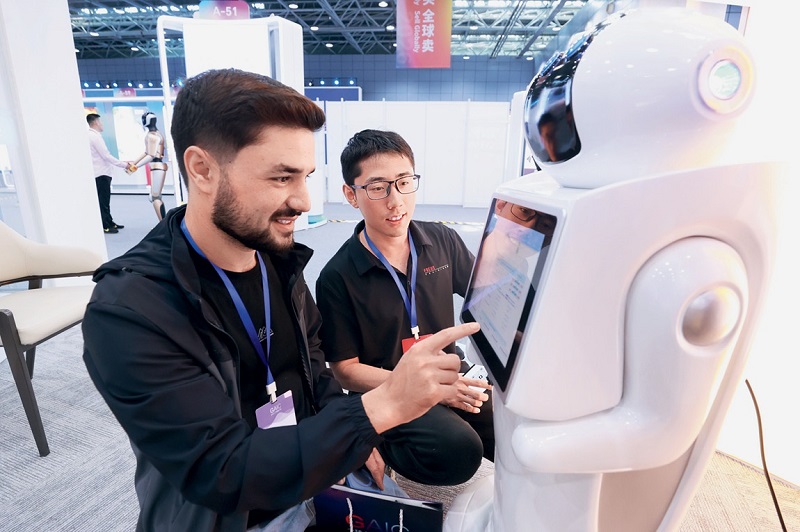
An international visitor reviews his health screening report after trying out a health screening robot at the 2026 Global Artificial Intelligence Conference in Beijing, on July 8, 2026.
China Today: Based on your firsthand observations, what concrete lessons should Europe take from China’s approach to technological deployment? Conversely, what insights might China gain from Europe?
Jeppe Søe: Let me answer with examples rather than compliments.
In the Gobi Desert, I visited a solar-thermal power plant where 12,000 heliostats track the sun and direct energy toward a molten-salt tower capable of generating electricity long after sunset. That facility is part of a much larger national effort: China now operates 24 commercial solar-thermal plants with a combined capacity of 2.1 million kilowatts, with another 26 under construction.
In Shanghai, I watched robots greet guests, handle room deliveries, and do laundry at a major airport hotel. Nearby, humanoid robots developed by the Shanghai-based company Keenon, were already serving food in McDonald’s restaurants.
This was not a demonstration prepared for foreign visitors. It was ordinary daily deployment. Europe has not matched that level of implementation at comparable scale. Europe’s problem is not a shortage of ideas; it is a tendency to turn every promising idea into a prolonged process of committees and consultations. We often spend years discussing decisions while China is already building.
At the same time, speed alone is not enough. I was raised with the Danish idea of “frihed til for skellighed” – the freedom to be different – and with respect for “hverdagens eksperter” – the ordinary citizens and practitioners who can challenge decisions from below. That may be Europe’s most valuable contribution: a culture in which criticism is treated not as disruption, but as useful information. China excels at rapid execution; Europe at self-correction and institutional accountability. Bringing those strengths together could produce something neither side can achieve alone.
China Today: China and Europe have taken different approaches to AI governance – Europe emphasizing regulation and ethics, China focusing on development and industrial application. Are these fundamentally competing models, or could they be complementary? Where lies the greatest potential for China-Europe cooperation?
Jeppe Søe: I see them as complementary, not contradictory. Treating them as opposing models is itself part of the problem. At the 2026 World Artificial Intelligence Conference (WAIC) in Shanghai, President Xi Jinping said AI should follow “a people-centered approach” and be developed “for the positive and for good.” Those ideas would resonate strongly with many Europeans, including those in Denmark. The deeper question is not whether AI should benefit people, but who defines “the people” and “the good.” That is precisely the conversation China and Europe need to have openly and directly.
Europe risks becoming a museum of ethical principles for technologies it no longer builds at scale. China faces the opposite risk: extraordinary industrial deployment, without always leaving sufficient room for the individual citizen who says, “This harms me.” Importantly, Chinese scholars themselves are raising these concerns. Zhang Linghan, one of the contributors to China’s recent AI ethics guidelines, has argued that human leadership and agency must not be weakened by technology. That is not an external critique imposed on China; it is an international debate taking place within China itself.
The most promising path forward is practical cooperation: joint working groups, shared standards for AI in healthcare and climate applications, and sustained technical collaboration. In these fields, the consequences of failure are measured not in market share, but in human lives.
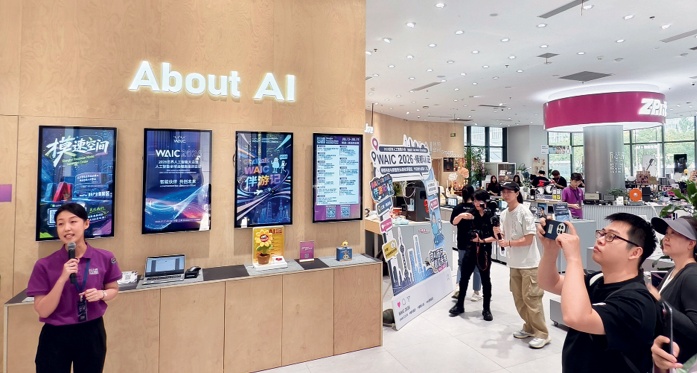
The nation’s first large-model innovation hub, Mosu Space (Model Speed Space), attracts over 300 AI enterprises, establishing AI as a defining feature of Shanghai’s Xuhui district during its innovation development, on July 20, 2026.
China Today: You have spoken about the Danish concept of “Dannelse” – the gradual cultivation of the whole person – and argued that the AI era requires “people with a compass in their hearts” rather than simply “minds crammed with facts.” What does this idea mean in practice?
Jeppe Søe: AI will always know more facts than any human being can. But it will never have shared a meal with you or sat across from you at a kitchen table. The defining challenge of the AI era is therefore not factual knowledge alone, but human judgment and character. “Dannelse” has no exact English equivalent. It refers to the formation of character through lived experience and encounters with people unlike oneself.
I grew up around Danish Folk High Schools, where my parents served as headmaster and headmistress. The core philosophy was that wisdom emerges through listening and dialogue, not through outperforming others in examinations. That is what our educational systems need to rediscover. The goal cannot be to compete with AI in memorizing information; humans will lose that race.
The real challenge is teaching young people how to engage with disagreement, uncertainty, and human complexity long enough to genuinely understand another person. Ironically, some of my strongest lessons in that regard did not come from Denmark. They came from conversations with Chinese students and business leaders in Beijing and Wuhan who openly disagreed with me and challenged my assumptions. Those exchanges mattered precisely because they were direct and honest.
China Today: As a former journalist and television news anchor, you have firsthand experience of how media shapes public perception. How can media on both sides move beyond superficial coverage and encourage more informed public discussion about China and Europe?
Jeppe Søe: During my years at the Danish television networks TV2 and TV3, I watched the industry increasingly embrace a simple formula: conflict attracts attention more than nuance. Every issue was framed as two opposing sides, with one winner and one loser. We are still living with the consequences of that mindset.
When European media reduces China to low-cost consumer platforms or geopolitical rivalry, it presents a caricature rather than a civilization with thousands of years of history and immense internal complexity. I assume Chinese media can sometimes portray Europe in similar ways. This is not a one-side problem.
Journalists should not behave like referees announcing winners in a boxing match. The responsibility of journalism is to uncover realities that do not fit neatly into predefined narratives. That requires reporters spending meaningful time on the ground, listening to ordinary people, rather than simply repeating official talking points translated from one language into another.
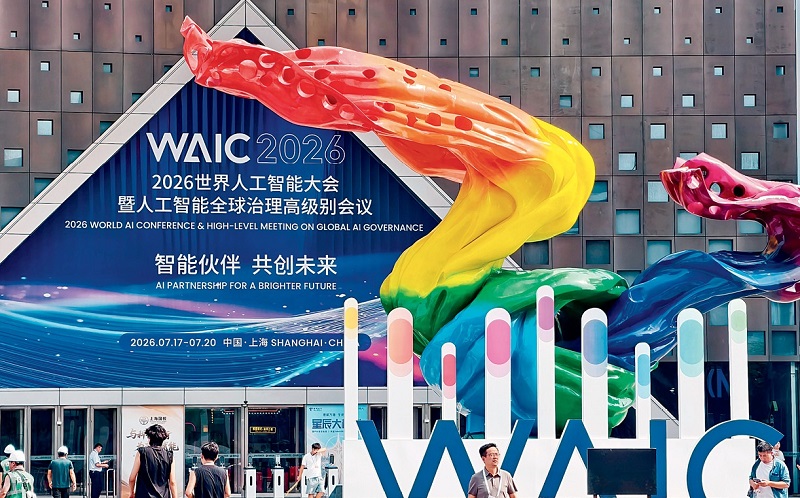
The 2026 World Artificial Intelligence Conference (WAIC) is held in Shanghai from July 17 to 20, showcasing over 1,100 enterprises with 3,000 exhibits.
China Today: What do you see as the most urgent and achievable priorities for China-Europe AI cooperation over the next three to five years? What obstacles must be overcome?
Jeppe Søe: The most urgent priority is to create channels for discussing AI that are not dominated exclusively by national security concerns. Security matters, of course, but when every conversation begins and ends there, broader conversations become impossible. What we need are sustained spaces for researchers, ethicists, businesses, educators, and ordinary citizens from both sides to discuss how AI affects human life in practical terms. I sometimes describe this idea as a “Global AI Folk High School” – not a formal institution necessarily, but a framework for open exchange without every conversation being filtered through geopolitical rivalry.
The larger obstacle is political distrust. I once left my own political party because I believed remaining inside a system that had lost its values would compromise my integrity. In a similar sense, I believe some of the existing frameworks shaping China-Europe relations are under growing strain and need renewed trust-building.
Neither side benefits from deepening mutual suspicion indefinitely. The alternative is clear: continue speaking about one another from a distance, or rebuild the habit of speaking directly with one another through sustained engagement and dialogue.