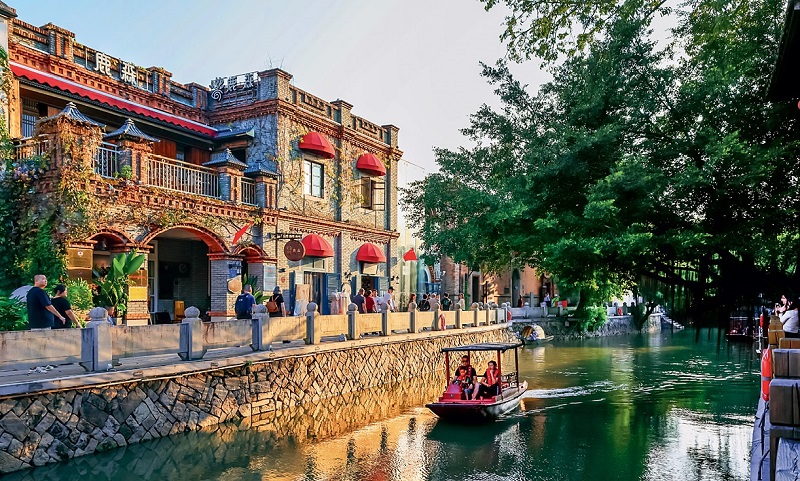
Water is the lifeblood of a city and the cradle of civilization. Fuzhou, the historic coastal capital of south China’s Fujian Province, has flourished for more than a thousand years on the strength of its waterways. Yet the city once struggled with chronic flooding, silted rivers, and declining water quality. Today, visitors strolling through the city are greeted by sparkling inland rivers, lush riverside parks, soaring egrets, and vibrant public spaces. Through technology-driven governance and widespread public participation, Fuzhou is reshaping the relationship between people and water, creating a modern urban landscape in which nature and city life thrive together.
Technology Safeguarding the City
Situated on China’s southeastern coast, Fuzhou faces frequent typhoons and intense rainstorms every year, marking flood protection a critical task for urban management.
To strengthen the city’s water security, the Fuzhou Urban Water System Joint Drainage and Dispatch Center has built a smart system that integrates the Internet of Things (IoT), big data, and digital twin technologies, providing unified forecasting, analysis, scheduling, and emergency response.
Inside the center, a giant digital screen displays real-time data on the rivers, reservoirs, pumping stations, and drainage pipelines across the city. “When a flood-control emergency response is activated, personnel from all relevant departments immediately convene in the command center to coordinate the operation they will take,” said Chen Yun, deputy director of the center’s Science and Information Division.
He said that the city’s drainage network information system is a critical component of Fuzhou’s flood prevention infrastructure. “Using pipeline inspection robots, we have surveyed, repaired, and digitally documented more than 2,500 kilometers of underground pipelines across the city. It amounts to a full ‘health check’ for the city’s underground drainage system.”
Digital technology is also transforming river management above ground. In addition to the traditional river patrols carried out by local river chiefs, Fuzhou has introduced an augmented reality (AR) river inspection system. Drones conduct semiannual aerial surveys of the city’s 139 inland waterways, collecting data on water quality, water levels, and hydraulic infrastructure, which is then integrated into AR-based river models that support long-term management and maintenance.
In Fuzhou, technology is not just cold code and machinery, but also a source of confidence in the face of natural disasters. According to Chen, when Typhoon Haikui hit the city with extreme rainfall in September 2023, Fuzhou adopted a coordinated basin-wide flood-control strategy: floodwaters were stored upstream, drained away midstream, and pumped out downstream. The city staggered reservoir releases to ease downstream pressure, activated detention basins, and dispatched grid-based emergency teams to flood-prone locations. As a result, floodwaters were cleared within eight hours, showing a new disaster response model that had changed from reactive to proactive flood prevention.
According to official statistics, Fuzhou’s smart water management platform has improved urban drainage efficiency by 50 percent and increased the storage and regulation capacity of its inland rivers by 30 percent. The system has successfully withstood nearly 20 typhoons and more than 400 episodes of short-term heavy rainfall.
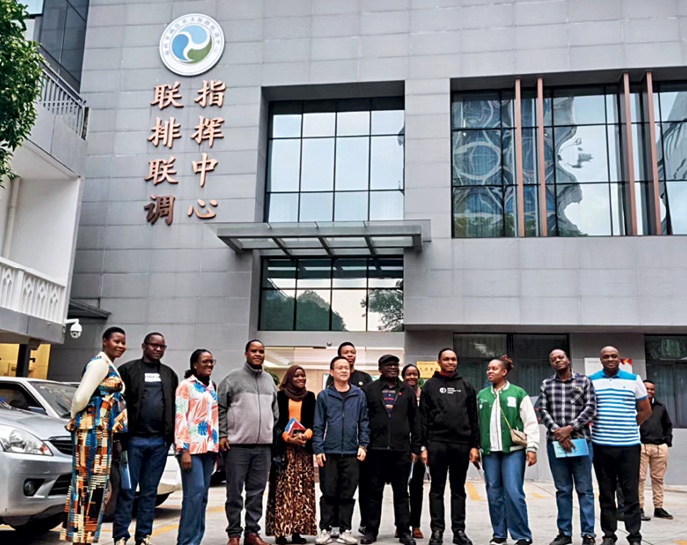
Foreign guests of the 2025 Overseas Elite on Governance pose for a group photo at the Fuzhou Urban Water System Joint Drainage and Dispatch Center during an exchange on November 22, 2025.
Restoring Urban Ecology
“For Fuzhou, flood control is only the first step. The greater goal is to restore the ecological vitality of our rivers and transform them from ‘safe water’ into ‘happy water,’” said Li Tao, manager of the Construction Department of Fuzhou Water Group.
Over the past decade, Fuzhou has been pursuing a comprehensive ecological restoration strategy in its urban development. The city has reconnected blocked waterways, identified and removed pollution sources before they could contaminate rivers, rebuilt ecosystems along riverbeds, water surfaces, and shorelines, and established smart monitoring systems to safeguard these gains over long term.
“Some years ago, the city paid little attention to biodiversity in managing its inland waterways,” Li said, “Working with scientific research institutions, we have since developed water ecology solutions tailored specifically to Fuzhou’s environment.”
Fuzhou West Lake served as the city’s pilot ecological restoration project. After the lake was dredged, shellfish, aquatic plants, and filter-feeding fish were released into it to help rebuild the ecosystem. “Within just six months, the water regained its natural self-purification capacity, with visibility reaching up to 1.5 meters,” Li said. This successful pilot project has since been replicated in other waterways across the city.
On many of Fuzhou’s rivers, traditional concrete embankments have also been replaced with eco-friendly riverbanks of gravel and vegetation, creating habitats for microorganisms and aquatic life. “Along the Taiyu River in Cangshan District, aquatic plant coverage has reached 70 percent, while the number of fish species has risen from just two to eight,” Li said.
Fuzhou has also embraced low-carbon water management by harnessing the Min River’s natural tidal forces. By channeling river water into the urban waterways at high tide and controlling the flow with sluice gates at low tide, the city replenishes its river network without any additional energy consumption. Each day, 16.5 million tons of water flow naturally into the urban water system, saving nearly 36.7 million kilowatt-hours of electricity and reducing carbon dioxide emissions by nearly 29,000 tons annually.
As water quality improved, Fuzhou’s waterfronts were transformed into vibrant public spaces. The city has built more than 500 kilometers of riverside greenways and linear parks, while raising inland river water levels by up to 1.8 meters. Today, visitors can experience the city from the water by means of 29 inland river cruise routes and 75 kilometers of navigable waterways that connect historic neighborhoods, traditional architecture, and cultural districts.
A Shared Commitment
Beyond government-led efforts, water governance in Fuzhou has become a citywide initiative driven by widespread public participation.
“When I first moved here more than 20 years ago, this river was basically an open sewer,” said Wu Ruling, a resident who lives near the Baima River and now serves as a volunteer river chief.
“The government invested enormous effort into cleaning the rivers and relocating polluting factories,” she said. “Now we can see greenery from our windows, fish have returned, and even egrets are back. Everyone in our neighborhood feels a responsibility to protect this environment.”
Like many longtime residents, Wu now takes part in volunteer river patrols, promoting environmental awareness and discouraging littering and illegal dumping. “Local residents’ awareness of river protection has clearly increased, and irresponsible behavior has largely disappeared,” Wu said.
Fuzhou has pioneered a “dual river chief” system that combines government oversight with corporate participation, while also building a strong volunteer network. Local residents can report problems through a smartphone app or the city’s public service hotline, allowing issues to be addressed quickly and efficiently.
Wu Xiangyan, a corporate river chief who has worked in water management for eight years, described the process as highly collaborative. “Residents can upload photos of river problems they spot through the app, as easily as placing an online order,” she said. “Government coordinators assign the task immediately, and our corporate river chiefs head to the site, resolve the issue, and report back. It creates a complete response loop.”
For Wu, the greatest reward is seeing families enjoy the revitalized waterfronts. “When I see children playing by the river and elderly people chatting under the trees, I truly feel the value of our work,” she said. To her, clean rivers and happy communities are the best recognition they could ask for.
To date, Fuzhou’s water governance model has attracted delegations from more than 160 cities across China and won many domestic and international awards. But for local residents, the success of these efforts is reflected less in trophies than in everyday moments: enjoying a cool evening breeze on a riverside walk, relaxing in the shade of riverside trees, and seeing clear, flowing water just outside their homes.
With real-time data displayed on smart platforms and citizens participating in environmental protection through their phones, Fuzhou’s water transformation stands as a vivid example of people-centered urban modernization – one in which technology, ecology, and public participation come together to create a more livable and sustainable city.