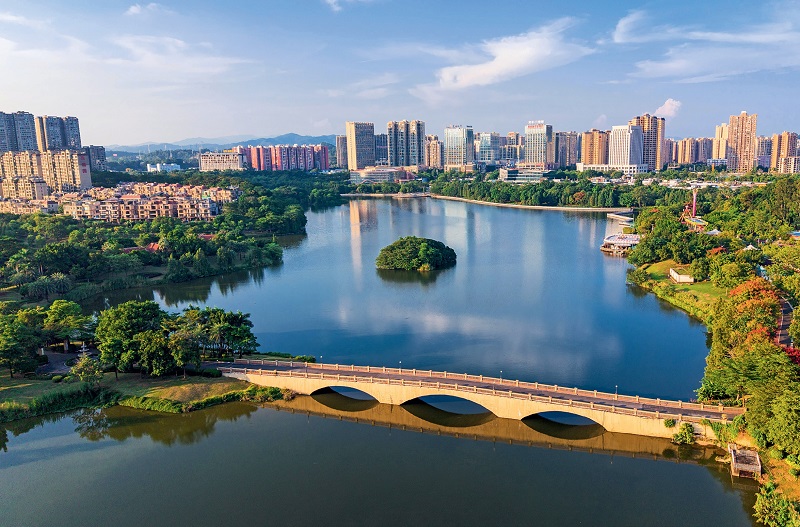
The well maintained lake, landscaped corridors, and surrounding urban buildings of the Rose Lake Park in Wuzhou City, south China’s Guangxi Zhuang Autonomous Region complement one another on September 17, 2026, creating a picturesque scene of a livable city.
Climate risks are no longer a hypothetical scenario. They manifest as sudden downpours, prolonged heat, swollen rivers, and the quiet erosion of ecosystems previously considered stable. Small wonder COP31, opening in November in Türkiye, has made implementation its watchword. The question is no longer whether to respond, but how to build systems that absorb shocks without sacrificing development or the natural foundations of prosperity.
The articles of this issue’s Special Report look at climate risks through China’s responses.
The Ecological and Environmental Code, in force since August 2026, supplies the legal backbone: it integrates scattered rules into one system and turns green transition, carbon markets, and climate commitments into binding obligations.
From there the view narrows to the ground. Fuzhou, in east China’s Fujian Province, shows how technology and public participation work as one – sensors, digital modeling, river chiefs, and residents’ “snap-and-report” tools turning flood control and river restoration into everyday urban governance.
Cities in north China like Beijing and Taiyuan illustrate engineering resilience: upgraded drainage, mobile pumping, sensor networks and physical barriers at underpasses keep northern cities functioning when rainfall exceeds predictions.
Yichang, in central China’s Hubei Province, shows how industrial transformation does not need to be costly: a chemical city once hemmed in by pollution has closed, relocated, and upgraded its industrial plants, turning waste streams into higher-value materials.
Xizang Autonomous Region reminds us that resilience is global: its glaciers, grasslands, and clean-energy systems regulate water and climate far beyond China’s borders.
Collectively, these stories describe a Chinese strategy: writing long-term commitments into law, managing cities as integrated systems, allowing industrial upgrading to be self-sustaining, and protecting the ecological foundations that hold everything together.