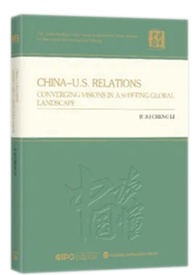
China-U.S. Relations: Converging Visions in a Shifting Global Landscape
Author: Li Cheng
Paperback, 191 pages
Published by Foreign Languages Press
The world today stands at another crossroads, where war and peace, polarization and coexistence, and decoupling and cooperation are deeply intertwined.
Against this backdrop, Li Cheng, a Chinese-American scholar with decades of experience researching China-U.S. relations at leading American think tanks, offers a penetrating analysis of the world’s most important bilateral relationship. Drawing on transformative historical changes, he places this relationship within the profound shifts in the global economic, political, and security landscape while dissecting the fractures and predicaments facing American politics, economy, society, and foreign policy.
In the book’s foreword, Li points out that although China and the United States have many contradictions and divergences, they share two fundamental interests: first, jointly safeguarding global economic and financial stability; second, averting great-power conflict to prevent any catastrophic war in the 21st century.
The book is divided into six sections. The first section, “Structure and Strategy,” analyzes the deep structural drivers behind the deterioration of China-U.S. relations and examines how America’s strategic paralysis reverberates across the globe and impacts China.
The second section, “Focus and Turbulence,” centers on the Taiwan question. Li argues that cross-Straits tensions represent a concentrated manifestation of intensifying mutual fear and antagonism, while also creating the main reason for deteriorating China-U.S. relations.
The third section, “Middle Class and Inclusiveness,” examines how the middle classes of both nations have fared differently across four decades of globalization: China’s expanding middle-income group versus America’s relatively contracting one. Li contends that Washington and Beijing should identify convergent interests to bridge their divide. The United States must reckon with the reality of China’s vast middle-income group. Only by understanding this group’s complexity, diversity, and evolving dynamics can it accurately grasp the full picture of China’s rise.
The fourth section, “Youth and Ideas,” focuses on the younger generations in both countries. China’s millennials and Generation Z, as digital-era “Internet natives,” tend to possess more diverse worldviews and richer international experience, and some have lived in the United States. On public issues such as climate change and gender equality, their views often converge with those of their Western peers.
The fifth section, “Sub-Provincial Engagement,” highlights a third force that is shaping China-U.S. relations: interlocal government and people-to-people exchanges. Over more than 40 years, the two nations have forged 50 sister province-state relationships and 284 friendly province-state and city partnerships. American state governments have established 27 representative offices in China, the largest number anywhere in the world. China is also the largest trading partner of 15 key U.S. states, including California, New York, and Florida, among them are political swing states such as Pennsylvania, Georgia, and Virginia. This demonstrates that China-U.S. relations are not only government-to-government based but also include bonds rooted among the peoples. Li therefore calls for reshaping the foundation of bilateral relations through deeper multicultural exchange.
The sixth section, “Reflection and Coexistence,” calls on the two countries to cooperate in the digital sphere to bridge the global digital divide. Among the world’s 70 largest digital platforms, Chinese and American companies together account for as much as 90 percent of total market value, with Microsoft, Apple, Amazon, Google, Meta, Tencent, and Alibaba alone accounting for two-thirds.
Li further emphasizes that reshaping China-U.S. relations requires intellectual renewal in think tanks and academia, correcting deeply ingrained strategic misperceptions in both countries, transcending habitual thinking, curbing the spiral of hostility, identifying shared interests, and creating a new wave of inclusive global economic growth.
As late U.S. Secretary of State Dr. Henry Kissinger (1923-2023) observed, today China and the United States approach parity in comprehensive strength – a circumstance unprecedented in modern history. Neither can annihilate the other without self-destruction, so war would yield no victor. This reality demands that both nations adopt radically new perspectives to enlarge their shared interests, achieving coexistence and mutual prosperity for global benefit.