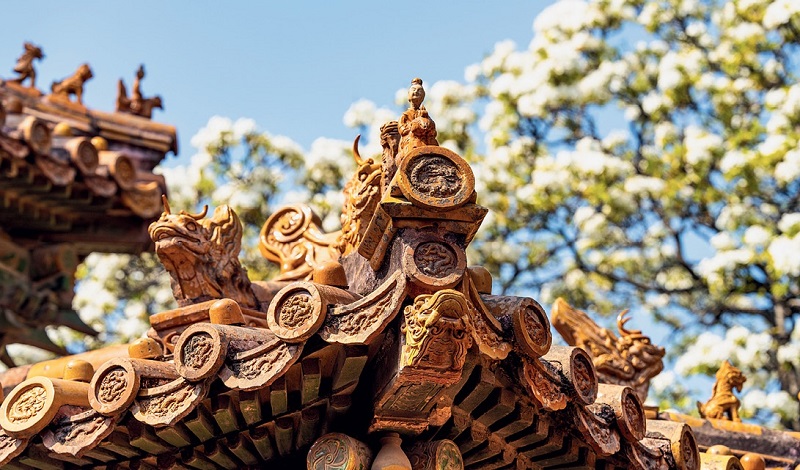
An image of Liuli roof ridges.
Liuli is a type of low-temperature lead-glazed material widely used in traditional Chinese architecture. Over the centuries, its presence in countless Chinese buildings has imbued it with rich cultural significance. The craftsmanship of liuli was added to China’s national intangible cultural heritage list in 2008.
Beijing served as the capital of the Liao (907-1125), Jin (1115-1234), Yuan (1206-1368), Ming (1368-1644), and Qing (1616-1911) dynasties, and liuli ornaments were ubiquitous of the imperial architecture from these periods. Many surviving liuli pieces originated from Liuliqu Village, about 20 kilometers west of the Forbidden City. Once a renowned center of liuli production, the village had imperial kilns as early as the Yuan Dynasty. Much of the liuli used during the Ming and Qing dynasties at iconic sites such as the Forbidden City, the Temple of Heaven, and Beihai Park was produced there.
The liuli produced at the village was renowned for being “large in size, free of cracks, and capable of retaining its color for hundreds of years.” The proportions of the ingredients and firing techniques were closely guarded secrets, while the exceptional quality of the liuli was partly attributed to a unique type of clay found in the region.
Imperial liuli architectural pieces were subject to strict standards for their grade, size, and placement, while their production involved a highly complex process. A single piece could take more than 10 days to complete and required over 20 steps, including clay refining, molding, carving, drying, firing, and glazing. From the 3.4-meter-long, 4-ton ridge ornament atop the Hall of Supreme Harmony in the Forbidden City to the blue liuli roof tiles of the Hall of Prayer for Good Harvests at the Temple of Heaven, each piece embodies the dedication and wisdom of generations of craftsmen.
Today, the more than 700-year-old official kiln site in Liuliqu Village has been transformed into a cultural park. The park regularly hosts educational programs and art exhibitions, while liuli-themed B&Bs offer a range of accommodation options.
An old firing kiln has been restored, and a new one has been built, both equipped with air purification and recycling systems. These facilities help revive traditional firing techniques through more environmentally friendly production methods. At the same time, the park has collaborated with the Palace Museum to research, preserve, and breathe new life into the centuries-old craft of liuli production.