CICG project retraces the Long March at Shaanxi, on 90th anniversary of the legendary journey.
A sharing and exchange session titled “The Enduring Echo of the Long March: Toward a Shared Future” was held in Yan’an, Shaanxi Province on July 24. The event formed part of the “Together on the Long March: 90th Anniversary of an Epic Journey” International Communication Project, initiated by China International Communications Group (CICG). It drew more than 100 experts, scholars, media representatives, and international participants from over 20 countries, including China, the United States, the United Kingdom, Germany, Spain, the Netherlands, and Guatemala. The session commemorated the 90th anniversary of the Long March victory, led by the Chinese Workers and Peasants Red Army, exploring its enduring relevance and global significance.
Since its launch on June 15 in Yudu, Jiangxi Province, the project has brought together Chinese and foreign experts and journalists to retrace the routes of the Red Army’s legendary march. Their journey took them through Guangxi, Guizhou, Sichuan, and Gansu before ending in Yan’an, on July 21. En route, they visited historic and contemporary sites, including Yan’an’s iconic Baota Pagoda, Ganquan Gelao Post Station, and the Memorial Park for the Victory of the Central Red Army’s Long March. Walking in the footsteps of the Red Army, the participants got first-hand experience of the scale of transformation over the succeeding decades. Their journey bridged time and space, connecting the heroic past with modern life.
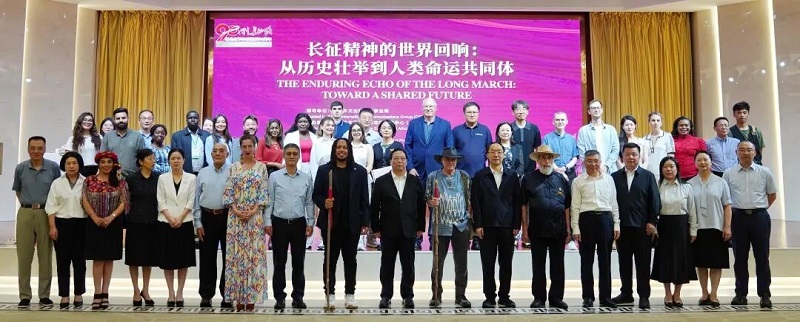
Marchers at the sharing and exchange session.
Feeling the Long March Spirit
On the Long March trail at the Gela Post Station in Shimen Town, Ganquan County, the mountain path was muddy after a rain. Red flags fluttered in the wind against a backdrop of terraced fields and lush forests.
Among the group, German scholar and freelance journalist Nils Bergemann stood out with a canvas bag emblazoned with the words “Serve the People” – a motto of Chinese Communists embodying public service and selfless dedication – slung across his chest.
“Even that short muddy stretch of mountain trail after the rain left us gasping for breath. It is almost unimaginable that the Red Army soldiers, with scant food, inadequate clothing, and scarce ammunition, could brave a hail of gunfire, scale bone-chilling snow-capped peaks, and cross marsh-ridden grasslands to complete the 25,000-li (about 12,500 kilometers) Long March,” he said. “The Long March is not a fictional tale from films or television; it is a chapter of real history.”
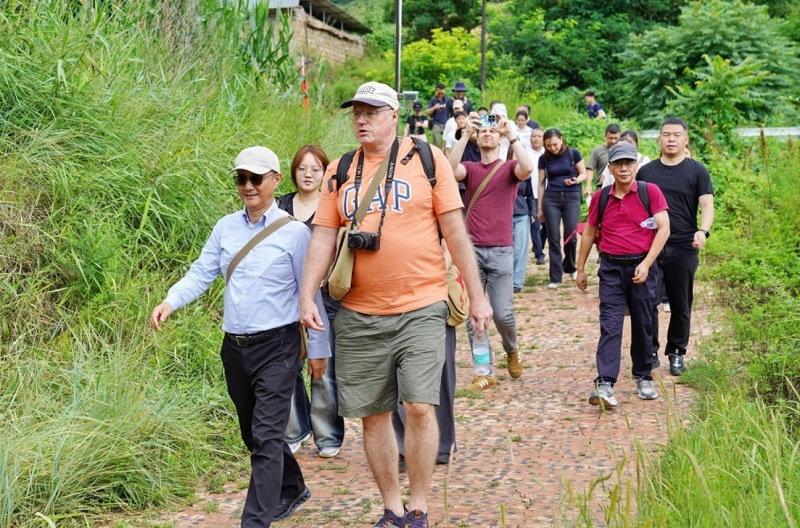
German scholar and freelance journalist Nils Bergemann (front right) on the Long March trail at the Gela Post Station in Shimen Town, Ganquan County.
David Ferguson, a senior editor at Foreign Languages Press and recipient of the Chinese Government Friendship Award, has spent the past six weeks tracing the routes of the Long March. He admitted that when he first set out, his understanding of the Long March was vague, “like a jigsaw puzzle with most of its pieces missing.” But after visiting key historic sites, such as the Xiangjiang River Battlefield, the Zunyi Conference venue and the Luding Bridge with its iron chains, he saw “a far more complete and fascinating picture.”
What moved him most were the battles to seize Luding Bridge and storm Lazikou Pass. “At those critical moments,” he said, “the success or failure of the entire Long March, and indeed the revolution itself, rested on the courage of just a small team of individuals. Under a hail of bullets and artillery, they charged forward at the cost of their lives.” He also observed that, “the Red Army lost more than half its troops, yet they refused to give up, persisting against all odds without compromise.” He summed up the essence of the Long March spirit as “exceptional leadership and unwavering conviction.”
At the former site of Mao Zedong’s Snowfield Speech in Xiangbiziwan Village, Ganquan County, Bergemann listened quietly to the guide’s narration. On November 5, 1935, amid heavy snowfall, Mao delivered a landmark address declaring: “The Long March is a manifesto, the Long March is a propaganda force, and the Long March is a seeding machine.”
It prompted Bergemann to say that a nation can only know where it is going when it truly understands where it came from.
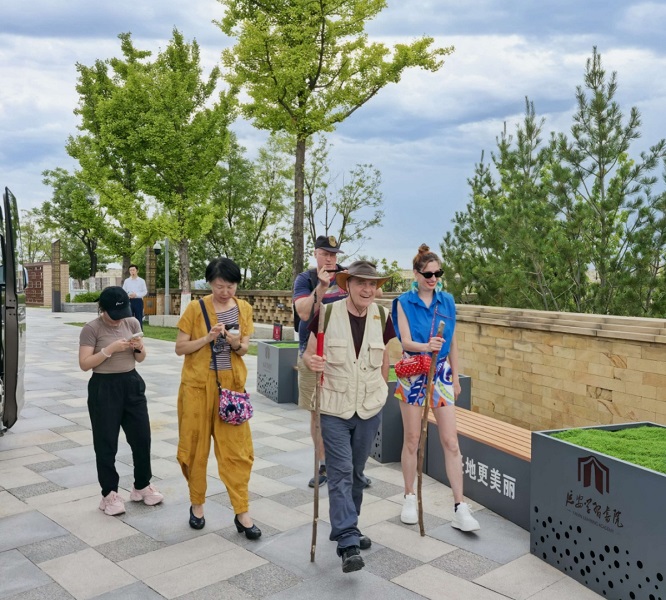
Chinese and foreign experts and journalists at the Yan’an Learning Academy.
Collective Hearts Reach Epic Heights
With its roots firmly embedded in the people, the Long March was not merely a military expedition but also a journey that awakened the masses. Along the 25,000-li route, the Red Army ignited the Chinese people’s passion for national independence and liberation. This swell of people power constituted a solid foundation for overcoming any challenge.
Mark Levine, an American professor at Minzu University of China and recipient of the Chinese Government Friendship Award, observed that Western narratives have often reduced the Long March to a distant, static historical anecdote. Yet his years of personal experience in China have demonstrated that the Long March spirit remains a vibrant, living force. It is felt in the social responsibility of students, in the resilience of rural communities, and in the courage of technology innovators. It lives in the tech pioneers who defy foreign blockades to dictate their nation’s future. It is also present in farmers who rebuild their communities after natural disasters, and in every ordinary citizen who values collective progress over personal comfort.
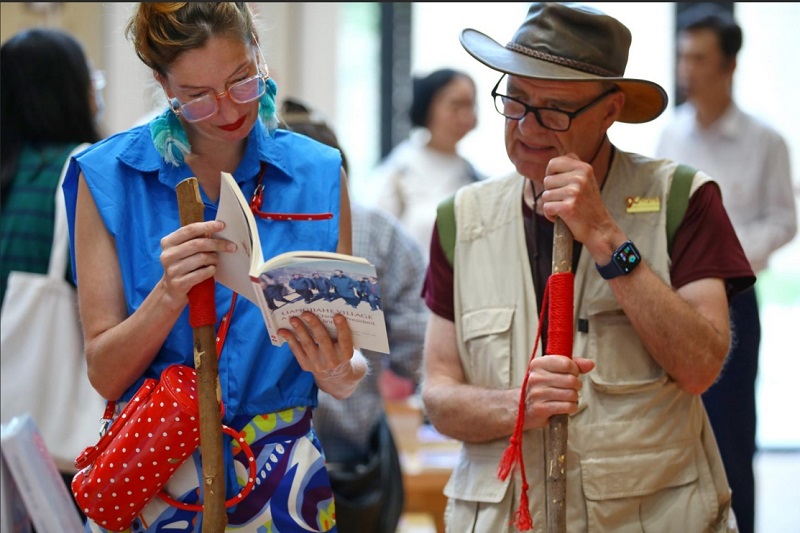
David Ferguson (right), recipient of the Chinese Government Friendship Award and honorary English editor-in-Chief of Foreign Languages Press, pauses with Dutch sinologist Elsbeth van Paridon, at President Xi Jinping’s “book wall” in Yan’an Learning Academy.
Elsbeth van Paridon, a Dutch sinologist and expert at CICG’s Center for the Americas, likened the Long March to the collective memory of D-Day for the Western world. She said the Long March’s spirit of “putting the people first” continues today in new forms, such as the integration of revolutionary sites with rural tourism, which boosts the local homestay economy and attracts young people to return to their hometowns to start businesses. “The Long March spirit is not a frozen relic of the past,” she said. “It is a living heritage that continues to empower people of today and transform lives.”
Julissa de Molina, a Guatemalan journalist, deeply resonated with the sacrifice and perseverance embodied in the Long March spirit. During her visit to Yan’an, she saw concrete examples of China’s rural revitalization and drew parallels with the development challenges facing Central American villages. She called for the Global South to strengthen experience sharing and exchanges, ensuring that cultural preservation is integrated into development, so as to achieve common progress that leaves no one behind.
At the Gela Post Station section of the march, Chang Bo, president of CICG, told Guyana media that developing countries account for 85 percent of the world’s population. They share similar histories of striving for national independence, traditions of mutual respect and friendship, and a common goal – each exploring a path to modernization suited to its own national conditions. CICG, he said, will walk hand in hand with partners in Global South countries to promote exchanges and mutual learning among civilizations, contributing to the practice of shared human values, and the building of a community with a shared future for humankind.
Generational Anecdotes Bring March Alive
If strategic decisions and grand battles formed the framework of the Long March, then the stories of ordinary people gave this period of history its substance.
Karol Kasinowicz, a British journalist with CICG’s Center for Europe and Africa (publisher of China Today magazine), admitted that before this journey, he had little grasp of what courage the Red Army displayed in seizing Luding Bridge, or why Yan’an became a holy land of the revolution. But as he walked down the Long March trail at Gela Post Station and heard stories of villagers sharing their last eggs and hand-rolled noodles with exhausted soldiers, and of the Red Army voluntarily compensating a villager with silver coins for accidentally cracking a water vat, he felt he had finally connected with the real people behind the history.
“These stories resonate more deeply than any superhero legends, because the longing for a better life amid hardship, the pain of losing loved ones, and the kindness between strangers are universal human emotions,” Kasinowicz said. “What makes the Long March unforgettable is not merely the historical events themselves, but the people behind them. The enduring legacy of the Long March spirit lives on in the memory of every individual.”
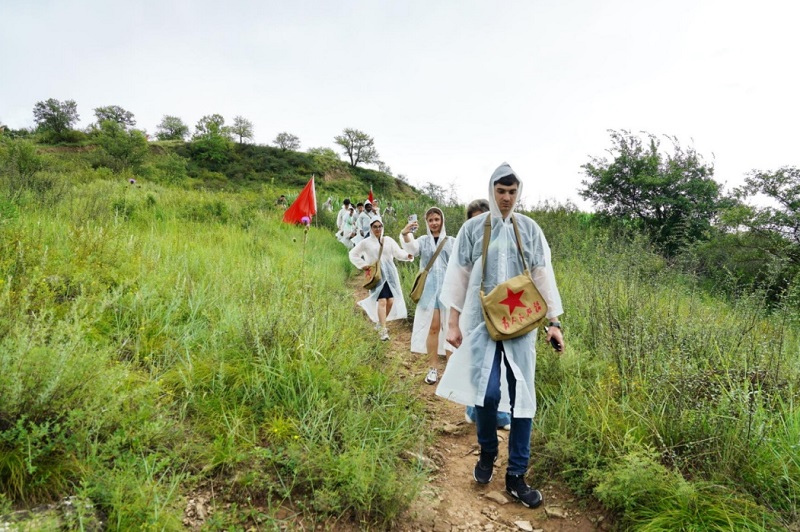
Chinese and foreign experts and journalists on the Long March trail at Gela Post Station in Shimen Town, Ganquan County.
After visiting the Yan’an Revolutionary Memorial Hall, the former site of Mao Zedong’s Snowfield Speech, and the Wuqi Revolutionary Memorial Hall, Bergemann was deeply moved. “In Germany, ordinary people know almost nothing about the Long March,” he said. “Only a handful of sinologists have a superficial understanding. This is a significant gap in global historical memory.”
“If we want foreign audiences to truly understand the Long March spirit, relying solely on written historical records is insufficient. Documentary films, immersive onsite visits, and firsthand oral accounts from eyewitnesses are far more effective vehicles for communication,” Bergemann said. He suggested that documentary productions centered on Red Army soldiers and revolutionary families would allow international audiences to connect emotionally and grasp the sacrifice and perseverance behind the Long March.
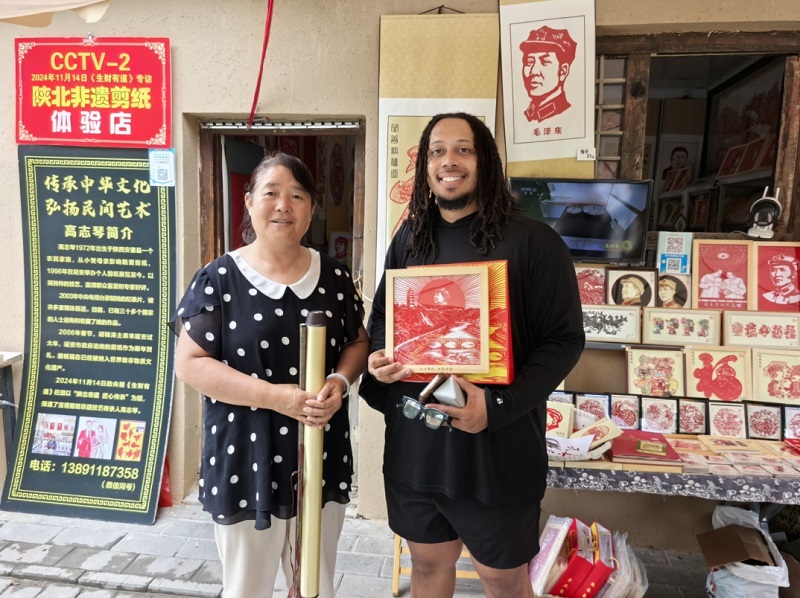
Zhavier Harris (right) holds a paper-cutting artwork, an intangible cultural heritage art of northern Shaanxi.
Zhavier Harris, marketing & communications manager of the Springfield Urban League in the United States, first took part in a “Retracing the Long March” activity as an intern journalist in 2016. A decade later, returning to this path, he found that with personal growth, history now speaks to him in a different way.
This time, he met descendants of Red Army veterans and listened to their family histories. He was particularly struck by a young student in Xing’an, Guangxi, who voluntarily delivers over 100 lectures on the Long March to his classmates each year. That dedication made Harris realize that preserving history must begin with inspiring the next generation.
“Every step through mountains, valleys, and villages reminded me: history is ultimately about people. Understanding cannot be built from afar; it can only be forged through dialogue, shared experiences, and the willingness to approach one another as fellow human beings.” With this in mind, he plans to lead American primary and secondary school students to China annually – not only to study Long March history, but to experience Chinese culture, build lasting impressions, and cultivate a new generation with global vision, empathy, and mutual respect.
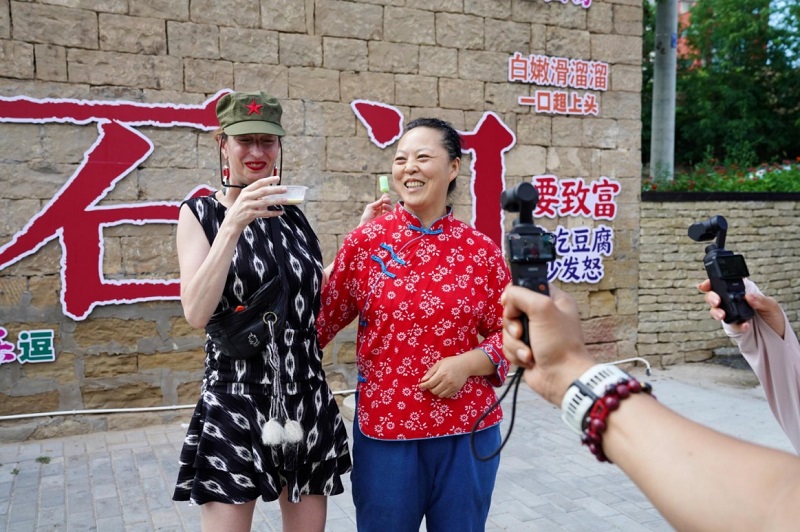
Elsbeth van Paridon (left), a Dutch sinologist, poses with Zhang Guihong, a fourth-generation inheritor of intangible cultural heritage, at Shimen Tofu Town in Ganquan County.
Long March Spirit Embodied in Modern Actions
“Why does the Long March still hold such significance in contemporary China?” Bergemann’s answer is clear: the Long March explains where modern China comes from, and why resilience, unity, and perseverance remain such vital values today. The story did not end in 1936, nor in 1949. It continues to hold profound practical significance in China today.
He noted that the Long March serves as a spiritual thread running through China’s past, present, and future. “Just as the Red Army overcame countless hardships to open a path for the nation’s survival, humanity today faces common challenges such as climate change and regional conflicts. We equally need a New Long March, a collective pursuit of peace, development, and solidarity for all of humanity.”
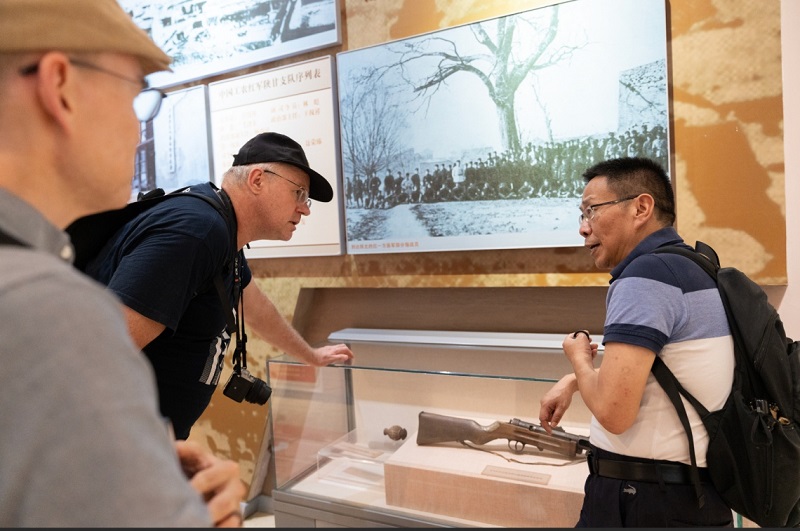
German scholar and freelance journalist Nils Bergemann (center) at the Wuqi Revolutionary Memorial Hall.
Over his 20 years in China, Ferguson has seen many “New Long Marches” firsthand. The first was the national response to the 2008 Wenchuan earthquake. That burst of national solidarity that mobilized the entire country was, in his view, a direct continuation of the Long March spirit. Another was targeted poverty alleviation – China’s eight-year sustained campaign to lift nearly 100 million people out of absolute poverty, which Ferguson regards as another monumental feat in human history.
“Why has China succeeded where others have not? Because the leadership formulated a clear and coherent strategy, breaking down ambitious goals into actionable steps; and at the grassroots, millions of ordinary people put those plans into action through their own deeds,” he said. He recalled a young Uyghur woman he met in Xinjiang who used e-commerce and modern design based on traditional Atlas silk patterns to help her fellow villagers prosper. “She is like a young soldier in the Red Army. Targeted poverty alleviation was not charity; it gave millions of ordinary people the opportunity to realize their dreams.” Ferguson said, “This is the most vivid and remarkable interpretation of the Long March spirit in our time.”
In a video address at the sharing and exchange session, José Luis Centella, president of the Communist Party of Spain, paid tribute to the 90th anniversary of the Long March. He described it as a historic feat of the 20th century and a model of how a political organization can maintain strategic resolve, unity, and resilience under extreme adversity, offering valuable lessons for political parties worldwide. He stressed that the Long March spirit has been translated into concrete actions in the new era: upholding a people-centered stance and defending national sovereignty. It will continue to inspire efforts to build a community with a shared future for humankind and address global uncertainties.
The Long March spirit belongs to China, and the world. Ninety years on, the path of the new-era Long March continues to unfold. This path is illuminated by the hard work and resilience of ordinary people, and by the pursuit of mutual understanding between civilizations.
As Chinese and foreign visitors observe China through their own eyes, tell China’s stories in their own words, and connect China with the wider world through their actions, this global resonance of the Long March spirit itself stands as the finest tribute to that historic epic. History lives on in the choices of every generation, and in the sincere exchanges that bridge divides.
(Photos by Yu Jie and Zhou Lin of China Today & Yang Jia of China.org.cn)